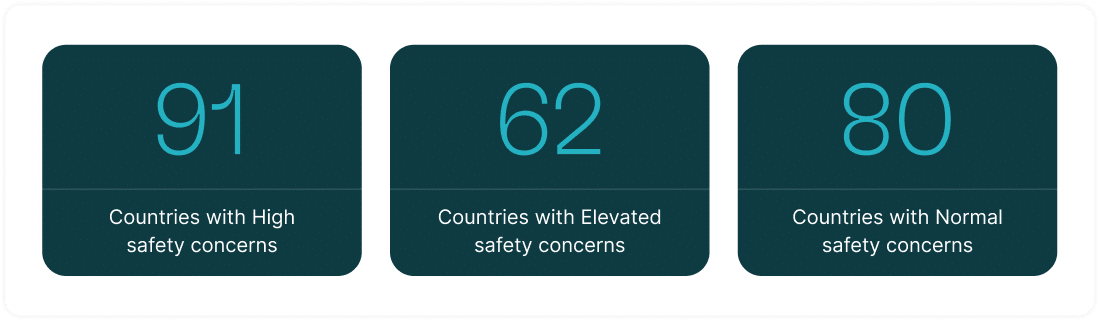
Riskline has launched the 2026 LGBTQ Risk Map. It classifies 91 countries as high concern, 62 as elevated concern and 80 as normal concern. The map highlights a growing wave of rights rollbacks. These range from new criminalisation laws to stricter documentation requirements, creating concerns for travellers, travel managers and duty-of-care professionals.
Western Europe remains the safest region for LGBTQ travellers, with all destinations rated normal concern. By contrast, the Middle East and North Africa are the most high-risk regions, where the vast majority of countries are classified as high concern, with only Israel rated as normal concern and Lebanon as elevated concern. Sub-Saharan Africa sees almost 80% of destinations rated high concern.
“ Our annual map tracks legal and social developments worldwide. It helps identify destinations where LGBTQ travellers may face increased risk. It combines legal frameworks, social attitudes, destination intelligence and NGO data into regularly updated risk assessments, supported by our real-time Alerts and practical guidance for organisations managing traveller risk,” explains Lorena Peña, Riskline Travel Intelligence Team Leader.
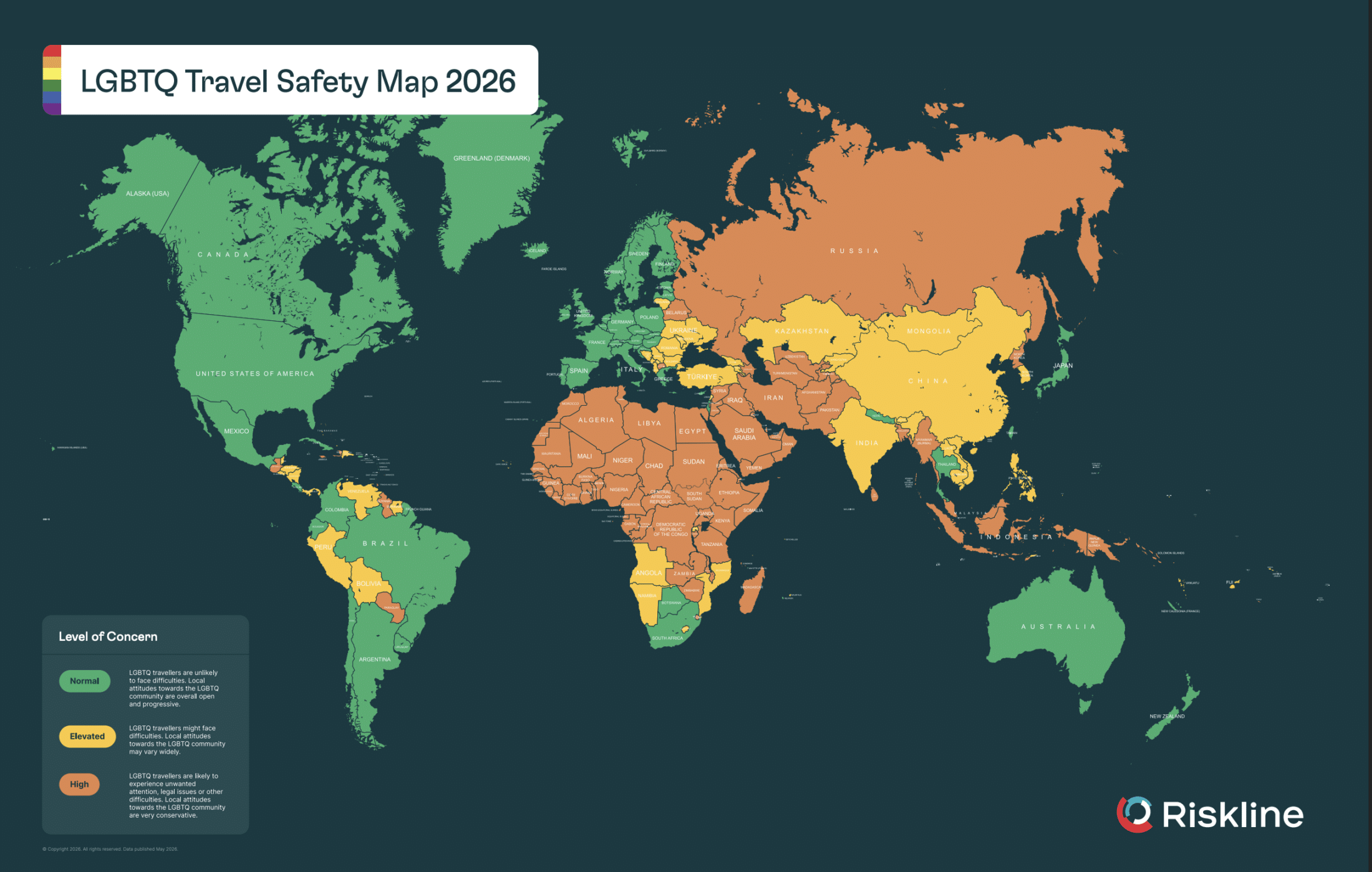
See the full map here.
2026 LGBTQ travel landscape: 10 key global highlights, mostly setbacks
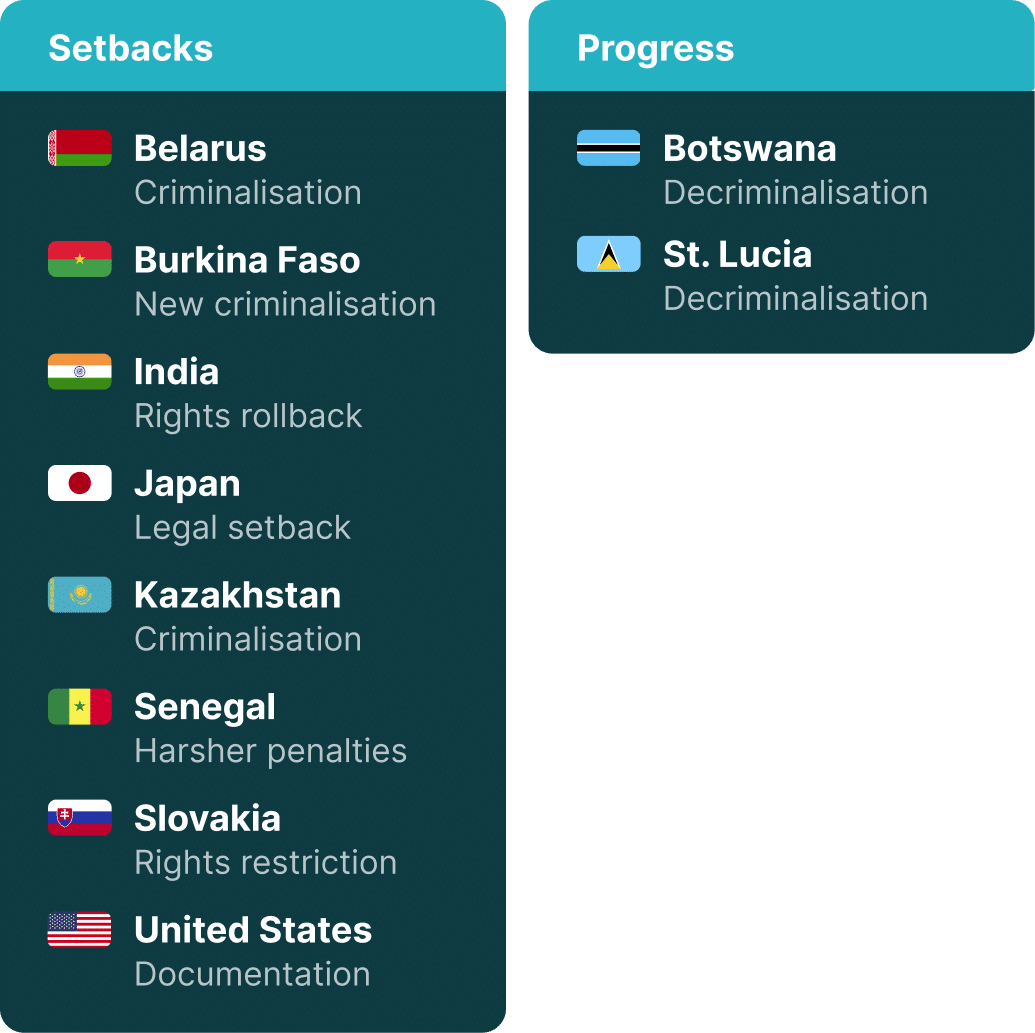
Over the past year, a small number of countries have taken steps to expand protections for LGBTQ people. However, these gains are increasingly outweighed by reversals in other parts of the world.
Africa: Progress and setbacks
In the Caribbean and Southern Africa, there have been notable legal shifts in a positive direction. In St. Lucia, the Eastern Caribbean Supreme Court struck down laws criminalising male same-sex relations, which had previously carried penalties of up to ten years in prison. In Botswana, authorities removed Penal Code provisions that had long criminalised same-sex relations, eliminating the risk of prison sentences of up to seven years.
Elsewhere, however, the picture shifts towards restriction. Across Africa, several countries have moved to harden their legal stance. Burkina Faso introduced its first law criminalising homosexuality following the 2022 coup, with penalties of two to five years in prison and deportation for foreign nationals. Senegal doubled prison sentences for same-sex relations from five to ten years.
Europe and Eurasia: New restrictions emerge
In Europe and parts of Eurasia, a similar tightening of restrictions is taking shape, though through different legal mechanisms. In Kazakhstan, authorities introduced a ban on the dissemination of information on “non-traditional sexual orientation” in public spaces, media, and online platforms. In Slovakia, new legislation moves to restrict adoption rights for same-sex couples while reinforcing national authority over EU-level LGBTQ protections. In Belarus, lawmakers passed a sweeping bill criminalising so-called ‘LGBT propaganda’, which could result in fines, community labour, or arrest; however, it is still pending presidential approval.
Asia: Rights protections challenged
In Asia, legal and policy developments have moved in opposite directions to earlier rights-based progress. India’s 2026 Transgender Persons Amendment Bill removes the right to self-identification established by a landmark 2014 Supreme Court ruling, replacing it with medical and administrative verification. In Japan, the Tokyo High Court ruled that the ban on same-sex marriage is constitutional, a decision that contradicts several earlier court rulings.
North America: Documentation requirements tighten
In North America, documentation policies have regressed for non-binary people. The United States Supreme Court upheld a policy banning the “X” gender marker on passports, requiring documents to reflect sex assigned at birth.
How Riskline calculates the level of concern for LGBTQ travellers
The assessment combines human expertise with open-source information. While some data come from the ILGA World Database, the team gathered additional information from Equaldex and other LGBTQ organisations. The assessment also draws on annual reports from NGOs and civil society organisations, as well as blogs, forums and traveller reviews.
Additionally, Riskline’s methodology is based on various criteria such as:
– Is homosexuality legal?
– Are transgender people legally accepted?
– Are same sex marriage and civil unions allowed?
– What is the level of LGBTQ social acceptance?
– Is entry with passport X allowed?
– Is entry with passport X safe?
The duty of care gap
“With 67 countries still criminalising same-sex relations, travel policies should reflect this reality. For LGBTQ travellers, these figures translate into real legal, cultural, and in some cases physical risk,” explains Lorena Peña, Riskline Travel Intelligence Team Leader.
That exposure is not experienced the same way globally. Legal enforcement, cultural attitudes, and documentation requirements create layered risks that standard travel policies often fail to capture. Just as importantly, these conditions are shifting quickly. Countries that posed no legal threat a few years ago may now criminalise LGBTQ identity outright.
Effective duty of care now requires dynamic, intelligence-led risk management. It must consider who is travelling as well as where they are going. This includes timely updates when laws change, destination-specific guidance based on real conditions, and policies that can adapt when risks shift. Organisations that take this approach can reduce exposure before travel begins. They can also support employees with relevant, personalised guidance and demonstrate clear, defensible duty of care standards.
Riskline provides LGBTQ travel safety intelligence across 233 destinations, helping organisations assess and manage traveller risk. Its analysis combines legal frameworks, social attitudes, destination intelligence and NGO data into continuously updated risk assessments, with destinations classified by level of concern and supported by real-time alerts and practical guidance to strengthen duty of care. Learn more about our LGBTQ travel safety data.