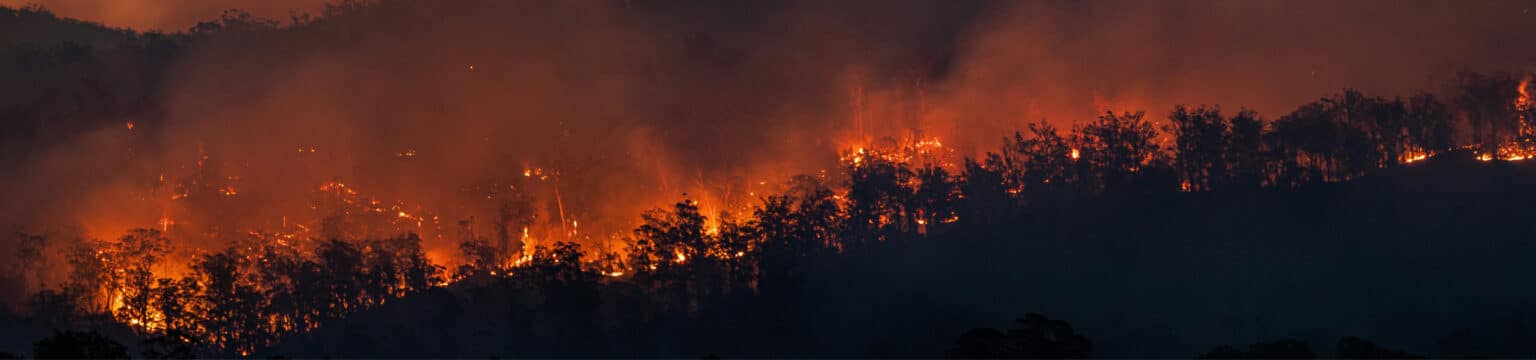
Unlike the EMEA and the Americas, fewer countries in the APAC (Asia-Pacific) region experience regular wildfires. The worst-affected countries include Australia, Indonesia and India.
In contrast to the 2025 La Niña, this year’s El Niño is expected to produce a longer, stronger dry season, exacerbating wildfire conditions and intensifying severe transboundary haze events affecting Indonesia, Malaysia, Singapore and Brunei. Massive wildfires in Australia and Indonesia often cause widespread haze and poor air quality, affecting not only local areas but also neighbouring countries.
Australia
Australia is frequently hit with bushfires, which are wildfires that burn in grasslands, scrublands or forests, with around 46,000-62,000 occurring annually. Bushfires kill dozens of Australians per year, while their smoke causes health complications that result in the deaths of nearly 500 people annually.
Bushfires in the country have also caused significant disruptions to overland and air travel, often leading to multiple road and airport closures. Travellers can also expect pre-emptive evacuations, sometimes on very short notice, within hours of a bushfire erupting. Power outages are a common occurrence during the bushfire season. Ahead of the peak, residents in bushfire-prone areas are sometimes warned by local governments to relocate to larger towns, shopping centres and shelters that can withstand fires.
While bushfires can occur all year round, each Australian state has a different bushfire season. In the southernmost parts of the country, such as the Australian Capital Territory, New South Wales, Victoria, South Australia, Tasmania and Western Australia, the threat of bushfire peaks from late spring until mid-autumn (mid-November to mid-April).
In the northern and eastern parts, the season can sometimes occur earlier than October, with parts of Queensland’s Far North experiencing peak fire danger from July to October. The Top End in the Northern Territory (NT) experiences bushfires from April to November, while the Central Australia region of NT, which includes Alice Springs, may experience this from October to March.
Indonesia
Indonesia experiences regular wildfires every year, which are often massive in size and primarily occur during the dry season between April and October. In 2025, wildfires burnt around 395,000 hectares (976,066 acres) of forests and fields, with the worst-affected provinces being East Nusa Tenggara, West Nusa Tenggara, North Sumatra, Maluku, Riau, South Kalimantan, East Kalimantan, East Java and Aceh.
Travellers should exercise caution when visiting forest areas in these provinces. While extreme heat during the dry season and lightning strikes can trigger wildfires naturally, many of Indonesia’s wildfires are caused by human activities, most notably poor waste management or the intentional clearing of land for palm oil plantations.
Meteorologists track ‘hotspots’, areas of elevated temperatures that serve as the primary indicator of potential wildfires. In conjunction with the La Niña event in 2025, there were fewer of these ‘hotspot’ areas than in 2024, which likely contributed to a reduction in both wildfire frequency and severity.
India
In the Indian subcontinent, forest fires are expected to increase significantly in the coming years due to rising temperatures. The frequency of forest fires in India has increased by 52% in the last two decades. The wildfire season in India generally occurs between November and June. Farmers usually engage in slash-and-burn activities in November, sometimes illegally. These activities have exacerbated bushfires in recent years.
The forests of northeast India are largely covered by dry deciduous trees that lose their leaves in autumn, making them more vulnerable to fire, while forests in southern India are less prone to fires as the vegetation is largely evergreen or semi-evergreen. However, the Forest Survey of India (FSI) data has recorded thousands of forest fires since the beginning of the year.
Central states, such as Madhya Pradesh, Maharashtra, Chhattisgarh, Andhra Pradesh and Odisha, have been the most affected, but fires have also been reported in Jammu and Kashmir, Himachal Pradesh and Uttarakhand in the north. A combination of dry winter and early heat waves due to anomalies in the weather pattern and other weather events, such as El Niño, which is also associated with a potential reduction in rainfall during the monsoon season, has contributed to the increase in forest fires in these areas.
Tamil Nadu’s wet forests also experienced some of the worst fires in their history. Some 3,380 fires were reported during the dry months (February to May) of the last season, more than twice as many as two years earlier.
Travellers visiting wildfire-prone regions of India should monitor local fire warnings and evacuation orders, particularly during the peak fire season.