Safety

We are experiencing more intense wildfires and longer fire seasons, with dry and windy conditions often increasing their speed and unpredictability. To protect communities and visitors, local authorities may issue pre-emptive emergency declarations, allowing them to deploy resources swiftly to at-risk areas.

Travellers heading to wildfire-prone locations are advised to stay updated with local news, official alerts and advice from authorities. This way, they remain informed of any developing threats or evacuation orders.

Evacuation advisories are often issued with a few hours’ warning before a wildfire reaches populated areas, but conditions can change fast, and fires can escalate well beyond that window. This is why people in at-risk areas are strongly encouraged to evacuate as soon as a voluntary order is issued, rather than waiting for it to become mandatory. 

If a fire has already cut off safe routes out by the time a warning arrives, authorities may instead advise sheltering in place, since attempting to evacuate at that point can be more dangerous than staying put. Visitors should follow designated evacuation routes closely and are encouraged to leave early rather than wait, particularly if they belong to a vulnerable group.

Signing up for government emergency alerts and using real-time wildfire information apps can prove invaluable in such situations. Most alerts will use a colour system and/or a ‘Ready, Set, Go!’ scale to measure the danger a wildfire is posing to life and property at a given moment.

Preparation can be critical during a wildfire event. Travellers should take time to understand local evacuation plans before they’re needed and pack an emergency kit with essentials such as water, non-perishable food, face masks and first-aid supplies. It’s also worth checking that accommodation in wildfire-prone areas has working smoke and heat detectors. Just as importantly, knowing how to recognise wildfire smoke and understand its behaviour can help travellers make faster, more informed decisions that could save lives.
EURO

Emergency Safety Directives

Pre-emptive local emergency declarations are common in regions prone to widespread wildfires each year. These declarations enable authorities to mobilise and deploy security and financial resources quickly to affected areas. Travellers heading to wildfire-prone regions should stay informed by monitoring local news, alert systems and updates from relevant authorities to keep track of such declarations.

Evacuation advisories are usually issued several hours before a dangerous wildfire is expected to reach populated areas. However, wildfires can spread unpredictably, especially under erratic, windy and dry conditions. This means a situation can rapidly escalate from an advisory to a warning or urgent evacuation. Leaving early in response to an evacuation warning or pre-emptive evacuation order is generally the safest option. Be ready to leave if local authorities advise, or if you feel you are in danger. In some areas which are highly prone to wildfires, authorities may advise residents to pre-emptively relocate to larger towns and cities with less forest cover or sturdier structures and shelters capable of withstanding fires, several days in advance. 

In some cases, conditions may deteriorate so rapidly that it becomes too late to evacuate, making sheltering in place the safest option. If you cannot leave during a wildfire emergency, seek shelter in a room on the side of the house opposite the approaching fire, ideally one with a clear exit. Keep windows and doors closed and turn off the air conditioning to prevent smoke from entering.

Visitors and residents are advised to follow official evacuation routes and opt for voluntary evacuations as early as possible, before conditions deteriorate and mandatory evacuation orders are issued. Those at higher risk, including individuals with medical conditions, older adults, pregnant women, children and those with disabilities, should prioritise leaving early.

To stay well-informed, monitor local media, weather forecasts and wildfire updates regularly. Sign up for free government emergency alerts and consider using smartphone apps that provide real-time wildfire information, evacuation routes and safety tips.

Preparing for the Risk of Wildfire

Being prepared and well-informed can help you make the right decisions and stay safe during a wildfire while travelling. It’s important to pack an emergency backpack with essentials well in advance of any potential evacuation. This should include non-perishable food, water, torches with spare batteries, face masks and a first-aid kit containing plasters, antiseptics, burn ointments, medicines and a thermal blanket – enough supplies to last at least 72 hours. Don’t forget to include important identification documents, medical records and travel documents such as your passport.

Take the time to familiarise yourself with escape routes, local community halls that may be designated as shelters and evacuation plans for the area you are visiting. Fill up your vehicle in case you need to evacuate. Before venturing into forested or wildfire-prone areas, consider attending safety briefings or workshops on wildfire awareness and prevention.

Store valuables such as cash, jewellery, electronics and important documents in a fire-resistant and waterproof container whenever possible.

Additional preparations include the following wildfire safety measures:
Smoke and heat detectors

If you are staying in an area prone to wildfires, ensure that your accommodation has smoke and heat detectors to detect fires early.

Be aware of local surveillance systems or community-based alert systems that can notify you of nearby wildfires. Have a battery-powered radio.

  • Carry a reliable mobile phone with a strong signal and consider bringing a portable charger or extra battery to keep your device powered.
  • A satellite messenger or personal locator beacon (PLB) can remain functional during network outages and allows you to signal for help when mobile phone coverage is unavailable.
  • Use a mirror as a signalling device and flash it three times, the universal signal for distress.

Always have a portable fire extinguisher in your vehicle or accommodation.

  • Consider carrying a fire-resistant blanket or clothing and thick-soled hiking boots to protect yourself from heat, flames and ash, as well as N95 masks for smoke and fine particles.
  • Wear loose-fitting protective clothing made from natural fibres like cotton or wool, covering from head to toe, as synthetic materials can melt quickly and cause more severe burns to the skin.
  • Make sure that everyone in your family or travel group knows where to assemble, what to do and what routes to take in case of an evacuation. 
  • Carry a physical map of the area with clearly marked evacuation routes and predetermined meeting points in case of separation during an emergency.

Register at the trailhead where required and share detailed trip plans with family or friends before travelling.

What to Pack
Travellers heading to wildfire-prone regions should stay informed by monitoring local news, alert systems and updates from relevant authorities to keep track of such declarations.

Identifying and Avoiding Wildfire Smoke and Flames

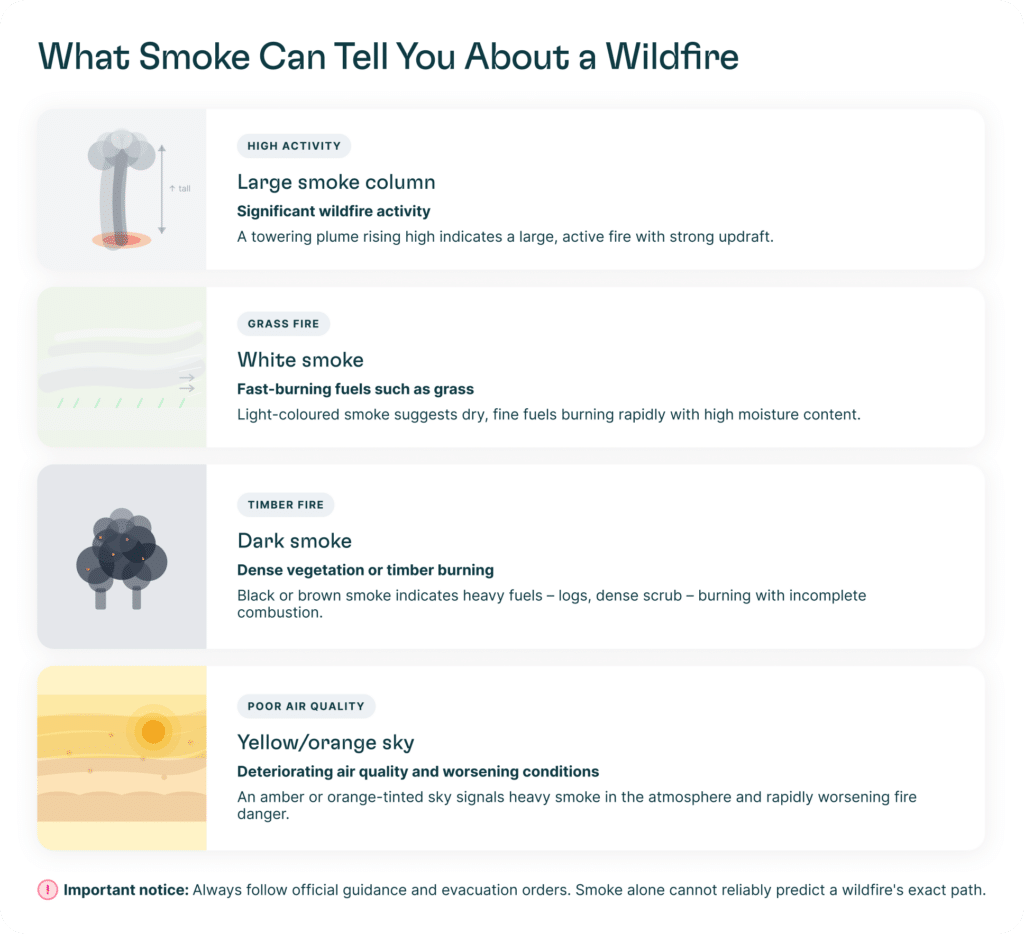
The presence of wildfire smoke does not necessarily indicate an immediate threat. Understanding the colour and behaviour of smoke can help you assess your situation and take the right steps to stay safe.

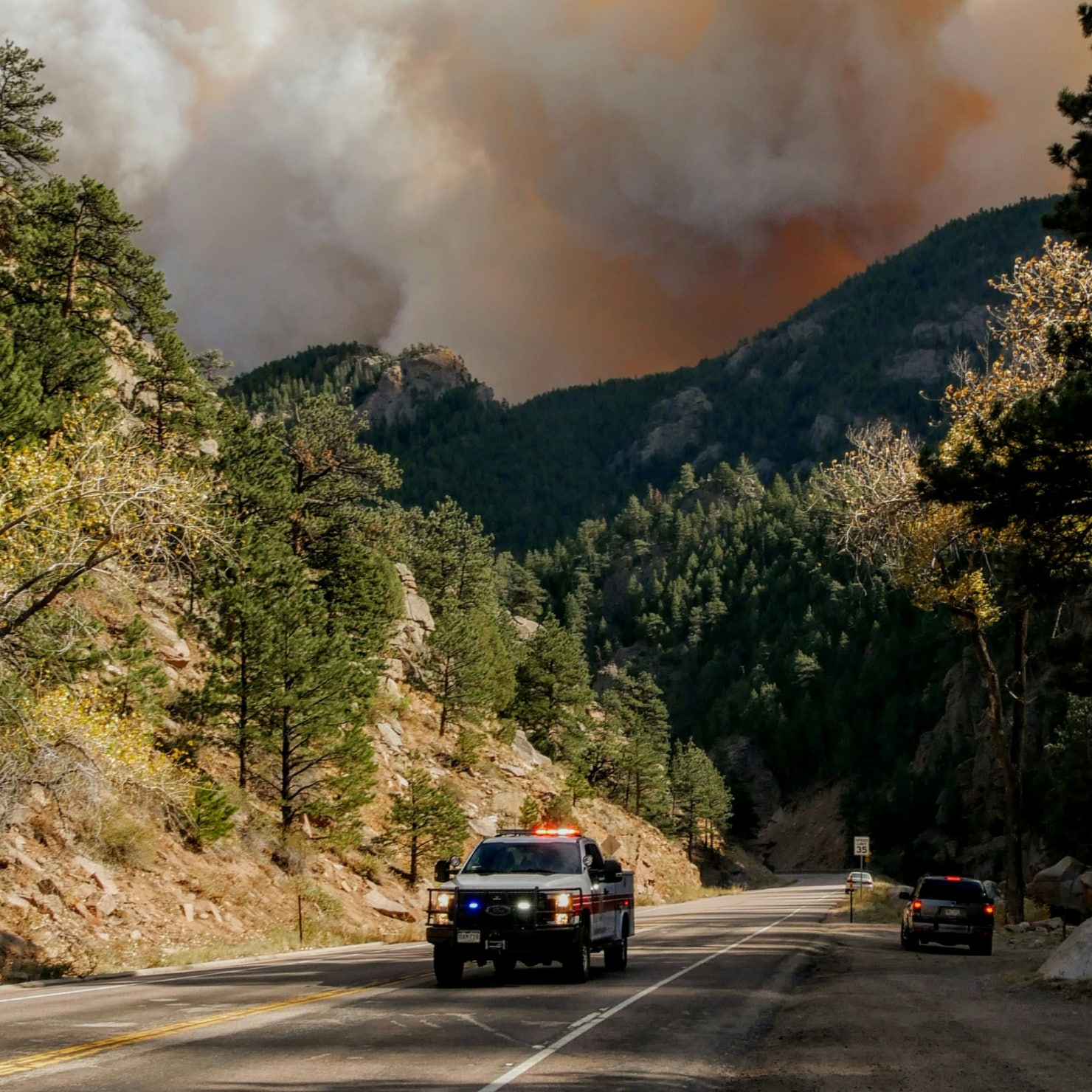
A large smoke column usually signals a major fire. The direction the column is blowing is driven mainly by wind, and while wind heavily influences how a fire spreads, it is not always a reliable indicator of the fire’s exact path. Always prioritise official guidance and evacuation orders over reading smoke yourself. If unsure, follow official guidance and move towards a safe area away from visible fire activity and heavy smoke.

Pay attention to your surroundings, as smoke levels can change rapidly throughout the day. Valleys may appear smokier in the morning because smoke settles into low-lying areas overnight. A yellowish-orange or reddish tint in the sky can indicate deteriorating air quality and worsening fire conditions. White smoke often comes from fast-burning fuels like grass, while dark smoke typically means a longer-lasting fire involving thick brush or timber. Dark smoke also signals a risk of embers jumping firebreaks or roads, potentially igniting new fires ahead.

What Smoke

When escaping smoke or fire, movement should be guided by official advice and local conditions. However, if you are suddenly ‘smoked out,’ move immediately. Dry lightning (lightning without accompanying rainfall) is also a serious hazard, as it can spark new fires with little to no warning. If you observe dry lightning nearby, stay alert for any sudden signs of smoke or fire in the area and be ready to move quickly if one develops. If you become trapped by a wildfire, seek shelter, cover your head and body and stay close to the ground, breathing through a wet cloth if possible.

Fires move uphill faster than downhill. Wide, flat areas with little vegetation are safer because there is less fuel to feed the fire. Paved, gravel, or dirt roads, as well as already-burned areas, may provide safer evacuation routes. Be cautious of hot ash pockets and ground heat, which can damage vehicles. Crossing waterways can be unpredictable, but wet areas and small streams without electrical hazards may provide safe escape routes. If evacuating by water, ensure that suitable boats or other watercraft are available.

Contributors:

Eeva Ruuska, Marco Tulio Lara and Ramya Dilipkumar

Editor:

Paul Mutter, Global Coverage Manager at Riskline

Share

Destination Research

Destination risk, safety & travel reports

Travel Search

Visa, health, safety & documentation

TripReady

Pre-travel security & travel safety advisories

Realtime Alerts

Breaking on-site travel risk updates 24/7

Travel and Tech Data

Data to improve user satisfaction

Technology Solutions

APIs, widgets and portal

The Informer

Articles, news and product updates

Newsroom

The latest developments at Riskline

Resources

In-depth content on relevant topics

Download the PDF