With contribytions by Claudia Gualdi, Farhan Rafi, Lorena Peña, Lorenzo Trevisan
Each year, we analyse global developments to assess where LGBTQ travellers are most at risk. Our 2025 LGBTQ risk map reveals a mix of progress and growing concern. While some countries have taken bold steps forward, others have reversed rights or hardened their stance.
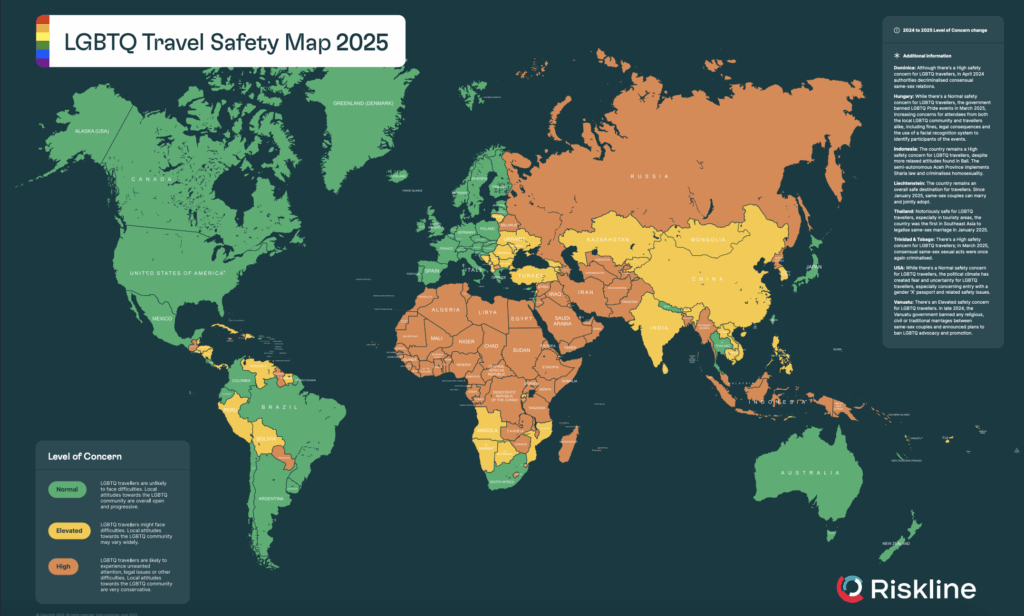
Here’s a snapshot of what’s changed in the past year and which destinations remain the most dangerous for LGBTQ people in 2025. Preview and download your 2025 LGBTQ risk map here.
2025’s Most Unsafe Destinations for LGBTQ Travellers
The following nations continue to be categorised as ‘High Concern’ in 2025, due to widespread legal restrictions, active criminalisation or extreme social hostility:
- 79 countries with Normal Safety concerns
- 63 countries with Elevated Safety concerns
- 91 countries with High Safety concerns
A Year of Contrasts
On the positive side, Thailand made headlines in January by legalising same-sex marriage – the first Southeast Asian country to do so. It’s a milestone that not only reflects growing social acceptance but also provides travellers and locals alike meaningful legal protections.
Liechtenstein remains an overall safe destination. Since January 2025, same-sex couples can marry and jointly adopt.
Elsewhere, progress has been more subtle but still significant. Dominica, for example, decriminalised same-sex relations in April 2024, a notable step forward in a region where laws remain largely hostile to LGBTQ people.
However, these positive changes are offset by growing concerns elsewhere:
- Hungary banned Pride events in March 2025, raising red flags for both locals and tourists. The use of facial recognition to identify participants has amplified fears of surveillance, discrimination and legal consequences.
- In Trinidad and Tobago, consensual same-sex acts were re-criminalised in March 2025, reversing years of tentative progress and triggering renewed safety concerns.
- Vanuatu introduced a ban on same-sex marriages and announced future restrictions on LGBTQ advocacy, signalling an increasingly hostile environment for the community.
Even destinations previously considered relatively safe are becoming more complex to navigate. In the United States, while overall categorised as a “Normal Concern” destination, LGBTQ travellers, particularly transgender individuals, have expressed growing anxiety due to an increasingly polarised political climate, especially regarding the use of gender ‘X’ passports and regional disparities in LGBTQ protections.
The Realities of LGBTQ Travel Safety
While many mainstream travel guides promote “inclusive” destinations, it’s vital that travellers and the companies supporting them rely on current, accurate intelligence that reflects both legal frameworks and lived realities.
With over 60 countries still criminalising same-sex relations, sexual and gender minorities face disproportionate risks worldwide. Even in regions seen as progressive, setbacks and policy reversals can happen swiftly, making safety assessments and cultural insight indispensable for informed travel decisions.
EURO
For another consecutive year, ILGA Europe’s latest Rainbow Map confirms the effects of the rethoric of far-right and conservative political forces in Central and Eastern Europe (Hungary, Slovakia, Italy, Romania). Hungary has taken constitutional and legislative measures banning public displays of LGBTQ identity and Pride assemblies. Meanwhile, countries such as Malta, Iceland, Belgium, Germany, Estonia, Greece and Liechtenstein have improved protections for the LGBTQ community, banning conversion practices, expanding hate crime laws and advancing marriage equality. Despite legal progress, everyday safety remains fragile. Hate speech incidents before elections (Romania’s Pride) and rising transphobia in countries like the UK, Italy, Ireland, France, Germany and Spain indicate that recent legal gains have yet to translate into safety conditions for the local LGBTQ communities.
MENA
In the MENA region, LGBTQ people continue to face serious legal problems and criminalisation is a prevalent problem everywhere. In 2024, there has been no noteworthy improvement in protection laws for LGBTQ people; quite the contrary. With the new penal code that went into effect on 13 December 2024 in Mali, not only is same-sex practice now punishable by law, but anyone considered pro-homosexual can be prosecuted. In Iran, Saudi Arabia and Yemen, same-sex sexual acts continue to be punished with extreme penalties, including physical torture, flogging and the death penalty. Other countries in the region, such as Tunisia, Iraq, Lebanon and Egypt, impose prison sentences ranging from three months to 15 years, often accompanied by fines and sometimes physical abuse and arbitrary detention.
SSA
In 2025, the outlook for the LGBTQ community in the SSA region remains particularly challenging, characterised by increasing repression and legislative measures that criminalise LGBTQ identity and expression. Many African countries maintain laws that criminalise consensual same-sex relationships, defining them as sodomy and which can also be used to repress other forms of LGBTQ expression. For example, lawmakers in Ghana reintroduced an anti-LGBTQ law that had been passed by the country’s parliament in February 2024 but had not been enacted. The law, known as the Human Sexual Rights and Family Values Bill, provides for prison sentences of up to three years for those who engage in same-sex sexual relations and up to five years for those who engage in the “intentional promotion, sponsorship or support of LGBTQ activities.”
APAC
The APAC region has seen a series of mixed developments for LGBTQ+ rights. While some countries have made great strides, such as decriminalising homosexuality or allowing same-sex couples to adopt, others have suffered setbacks or continued to struggle with discrimination. On January 23, 2025, Thailand legalised same-sex marriage, becoming the first Southeast Asian nation to do so. The law, known as the Marriage Equality Act, was passed by the National Assembly and received royal assent. On the other hand, in November 2024, Vanuatu’s Parliament amended the Marriage Act to explicitly prohibit same-sex marriages, regardless of their religious, civil, or traditional nature and LGBTQ rights in Vanuatu. This legislative action means Vanuatu does not recognise any form of same-sex unions, including civil unions. Alarming reports of serious human rights violations against LGBTQ people have been reported in Myanmar, where Rohingya individuals are specifically targeted, including with sexual and gender-based violence. In Afghanistan, since the Taliban authorities assumed power in 2021, they have enforced a strict gender order banning same-sex relationships and transgender identities based on their interpretation of Sharia law.
AMER
The AMER region hasn’t made significant progress in the past few months of 2025 for LGBTQ issues. Legislative initiatives and policy priorities can often be set on more traditional matters, especially as many countries in the region deal with high levels of crime or unstable economies, which leaves aside the focus on social affairs like LGBTQ rights. There is still a long road ahead, considering violence towards LGBTQ individuals is frequent in the region.
Though the United States (US) and Canada are friendly destinations for LGBTQ people with overall progressive protection laws, in recent years and more specifically in 2025, the US has witnessed more frequent attempts to limit freedoms and rights for LGBTQ people at both the state and federal levels. The latest change came with restrictions on issuing X passports for non-binary people.
The Caribbean continues to be the region with the least progress on LGBTQ issues. While some islands have embraced LGBTQ-friendly policies, attracting travelers annually, others still criminalize male homosexuality, leading to stigma against LGBTQ individuals. This is the case of Grenada, Saint Lucia, Jamaica and Saint Vincent and the Grenadines. In 2025, Trinidad and Tobago recriminalised same-sex relations, a big step back for the overall progress of the region.
On the bright side, 13 countries in the Americas still recognise same-sex marriage and several cities have already planned their Pride Parades for this year, including São Paulo with South America’s largest pride parade, Buenos Aires, Lima, Mexico City, Curaçao, San Juan, among others. Most main cities are open and have a vibrant LGBTQ community, where venues and activities are available too for LGBTQ travellers arriving.
Until true equality is achieved, increasing visibility, raising awareness and ensuring access to precise information remain essential tools in advancing safer, more inclusive travel for everyone.