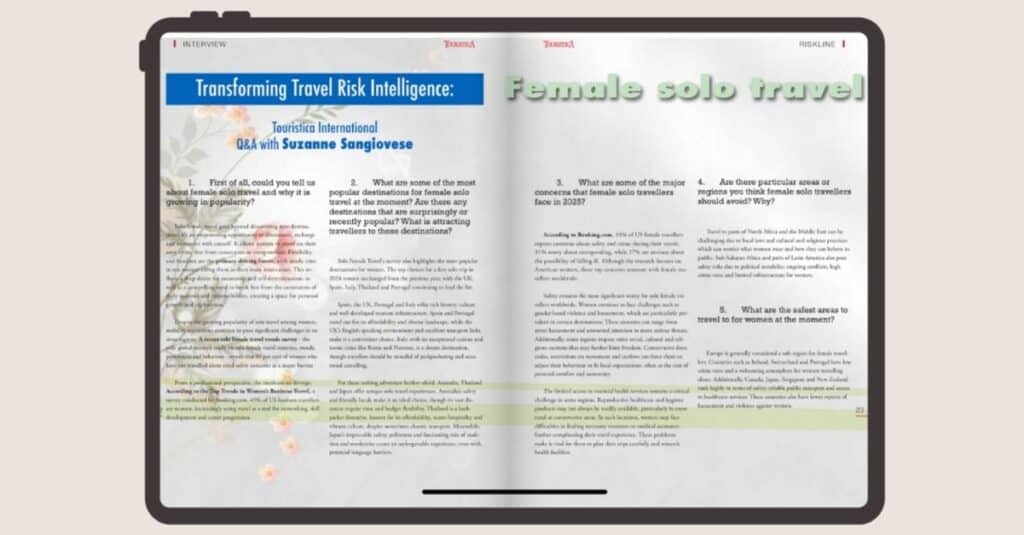
Our CEO, Suzanne Sangiovese, shares key insights on solo female travel with Touristica International
First of all, could you tell us about female solo travel and why it is growing in popularity?
Solo female travel goes beyond discovering new destinations; it’s an empowering opportunity to disconnect, recharge and reconnect with oneself. It allows women to travel on their own terms, free from constraints or compromises. Flexibility and freedom are the primary driving forces, with nearly nine in ten women citing them as their main motivation. This reflects a deep desire for autonomy and self-determination, as well as a compelling need to break free from the constraints of daily routines and responsibilities, creating a space for personal growth and exploration.
Despite the growing popularity of solo travel among women, mobility restrictions continue to pose significant challenges in various regions. A recent solo female travel trends survey – the only global research study on solo female travel statistics, trends, preferences and behaviors – reveals that 69 per cent of women who have not travelled alone cited safety concerns as a major barrier.
From a professional perspective, the motivations diverge. According to the Top Trends in Women’s Business Travel, a survey conducted by Booking.com, 45% of US business travellers are women, increasingly using travel as a tool for networking, skill development and career progression.
What are some of the most popular destinations for female solo travel at the moment? Are there any destinations that are surprisingly or recently popular? What is attracting travellers to these destinations?
Solo Female Travel’s survey also highlights the most popular destinations for women. The top choices for a first solo trip in 2024 remain unchanged from the previous year, with the UK, Spain, Italy, Thailand and Portugal continuing to lead the list.
Spain, the UK, Portugal and Italy offer rich history, culture and well-developed tourism infrastructure. Spain and Portugal stand out for its affordability and diverse landscape, while the UK’s English-speaking environment and excellent transport links make it a convenient choice. Italy, with its exceptional cuisine and iconic cities like Rome and Florence, is a dream destination, though travellers should be mindful of pickpocketing and occasional catcalling.
For those seeking adventure further afield, Australia, Thailand and Japan offer unique solo travel experiences. Australia’s safety and friendly locals make it an ideal choice, though its vast distances require time and budget flexibility. Thailand is a backpacker favourite, known for its affordability, warm hospitality and vibrant culture, despite sometimes chaotic transport. Meanwhile, Japan’s impeccable safety, politeness and fascinating mix of tradition and modernity create an unforgettable experience, even with potential language barriers.
What are some of the major concerns that female solo travellers face in 2025?
According to Booking.com, 35% of US female travellers express concerns about safety and crime during their travels. 31% worry about overspending, while 27% are anxious about the possibility of falling ill. Although the research focuses on American women, these top concerns resonate with female travellers worldwide.
Safety remains the most significant worry for solo female travellers worldwide. Women continue to face challenges such as gender-based violence and harassment, which are particularly prevalent in certain destinations. These concerns can range from street harassment and unwanted attention to more serious threats. Additionally, some regions impose strict social, cultural and religious customs that may further limit freedom. Conservative dress codes, restrictions on movement and curfews can force them to adjust their behaviour to fit local expectations, often at the cost of personal comfort and autonomy.
The limited access to essential health services remains a critical challenge in some regions. Reproductive healthcare and hygiene products may not always be readily available, particularly in more rural or conservative areas. In such locations, women may face difficulties in finding necessary resources or medical assistance, further complicating their travel experience. These problems make it vital for them to plan their trips carefully and research health facilities.
Are there particular areas or regions you think female solo travellers should avoid? Why?
Travel to parts of North Africa and the Middle East can be challenging due to local laws and cultural and religious practices which can restrict what women wear and how they can behave in public. Sub-Saharan Africa and parts of Latin America also pose safety risks due to political instability, ongoing conflicts, high crime rates and limited infrastructure for women.
What are the safest areas to travel to for women at the moment?
Europe is generally considered a safe region for female travellers. Countries such as Ireland, Switzerland and Portugal have low crime rates and a welcoming atmosphere for women travelling alone. Additionally, Canada, Japan, Singapore and New Zealand rank highly in terms of safety, reliable public transport and access to healthcare services. These countries also have lower reports of harassment and violence against women.
Are there any strategies or tips you would recommend to solo female travellers who are concerned about their safety?
In destinations with heightened safety concerns for women, travellers may face unwanted attention, such as catcalling, stalking or physical harassment. Friendly gestures, like smiling or engaging in small talk, can sometimes be misinterpreted. To reduce these risks, it’s essential to research local customs and be mindful of cultural norms around social interactions.
In countries like Iran or Afghanistan, women must adhere to strict religious customs, such as wearing a headscarf in public. In Saudi Arabia, while such requirements are not mandatory for visitors, it is still advisable for women to dress conservatively by wearing loose-fitting clothing that covers the arms and chest to avoid attracting unwanted attention.
Networking with other solo travellers can offer support. Planning transportation in advance, avoiding travelling alone at night and selecting female-friendly lodging with protective measures are also recommended.
For business travellers, companies should ensure their duty of care policies include tailored safety measures, such as pre-arranged transport and lodging close to meetings. Organisations must provide reliable communication and support throughout the trip and inform travellers about local customs and health services before departure.
How is technology helping to keep female travellers safe?
Technology plays a crucial role in ensuring the safety of female travellers, offering a variety of tools to improve navigation, communication and security. Apps like Google Translate and DeepL make communication easier, while offline maps through Google Maps or Apple Maps ensure they can find their way even in remote areas. Networking platforms, such as Tourlina and HeyVina, help solo travellers connect, creating a sense of community, while Flush assists in locating safe public toilets.
In addition to these apps, travel companies now provide real time alerts and safety indices that evaluate destinations based on factors such as local laws, healthcare access and cultural considerations. Pre-trip reports and risk assessments offer detailed information to help travellers make informed decisions about their destinations, highlighting potential concerns and available resources. These advancements empower women to navigate new places with confidence.
Read the full article on Touristica International (page 25).
Photo credits: Touristica International