With contributions from Farhan Rafi, Lorena Peña and Lorenzo Trevisan
Updated on 29 June
When authorities confirmed an Ebola outbreak in the Democratic Republic of Congo’s Ituri province, initial attention focused on Central Africa. However, the impact quickly extended beyond the outbreak zone. Within days, governments across multiple continents had imposed entry bans, quarantine and health surveillance measures to avoid the spread of the virus.
We’ve been tracking every development. Since 16 May, our team has issued 181 alerts, published an advisory and monitored health-related measures affecting travellers worldwide.
Riskline Ebola Outbreak Map and other resources
To assist travellers, Riskline has developed an Ebola outbreak surveillance map. It helps identify affected countries and regions, allowing travellers, travel managers and organisations to assess risks, review relevant measures and adjust travel plans accordingly.
Additionally, Riskline offers other useful resources, such as Alerts, Advisories and Destination Reports. These tools provide comprehensive information on health measures, entry requirements and travel restrictions across various regions.
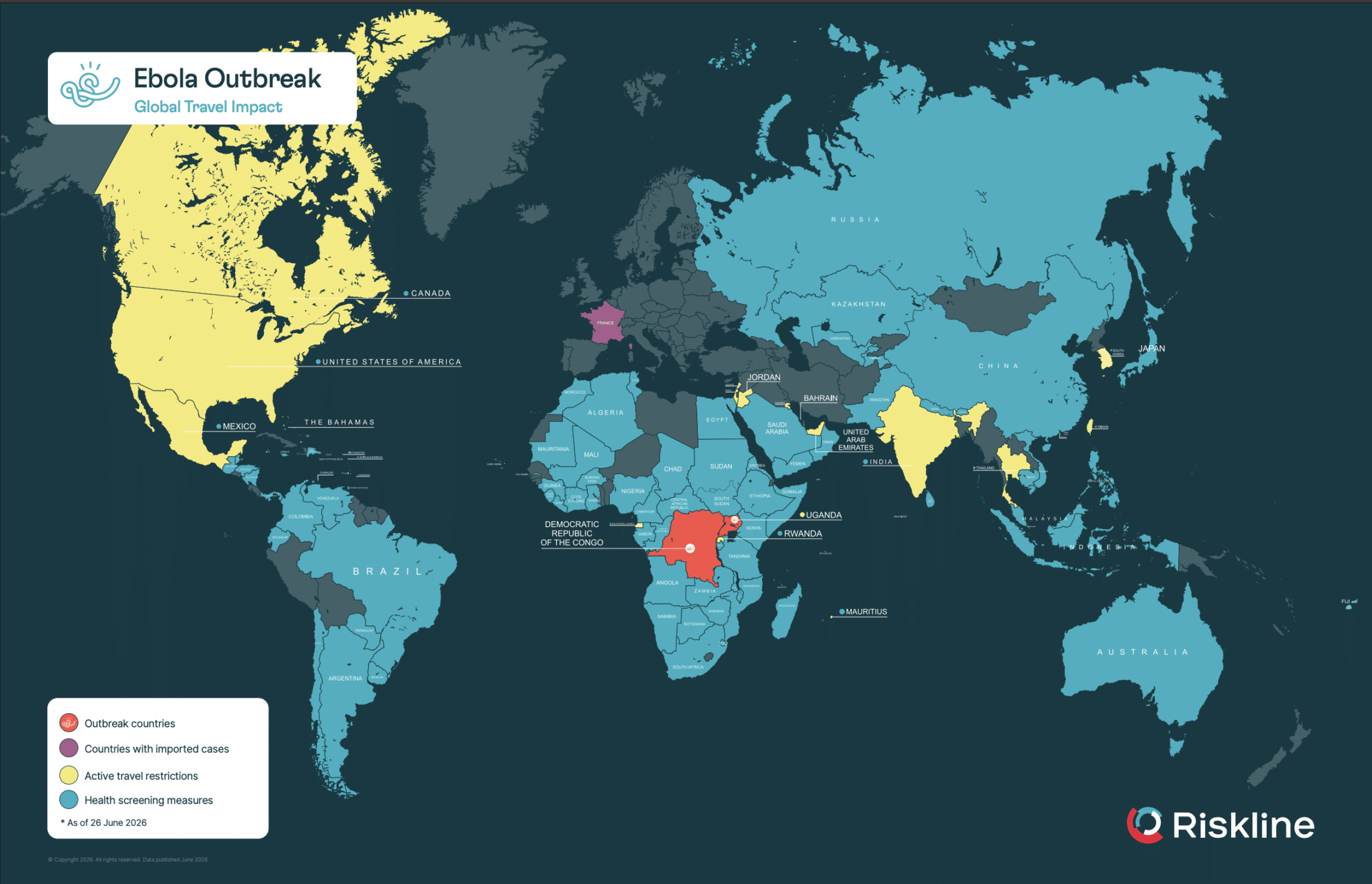
View the Ebola surveillance map in full size
The Riskline Ebola Outbreak Map provides a single consolidated view of outbreak developments, travel restrictions and health screening measures worldwide.
26 countries with stricter travel measures
The DRC, Uganda and France are the only countries to have reported cases so far. France’s single case was imported from the DRC. As of 26 June, 25 countries and territories had implemented stricter travel measures in response to the Ebola outbreak, including entry bans, quarantine requirements, visa issuance suspension, border closures and wider transport disruptions. These measures continue to affect both direct travel and transit routes across Africa, the Middle East, Europe and the Americas.
Travel restrictions or requirements are in place in:
- Antigua & Barbuda
- Bahrain
- Barbados
- Canada
- Curaçao
- Democratic Republic of the Congo
- Equatorial Guinea
- Haiti
- India
- Israel
- Jordan
- Kuwait
- Lebanon
- Macau
- Mauritius
- Mexico
- Rwanda
- Saudi Arabia
- Sint Maarten
- South Korea
- Taiwan
- Thailand
- The Bahamas
- Uganda
- United Arab Emirates
- United States of America
97 countries with health screening
We have also been tracking Ebola-related health screening measures at entry points worldwide. Common measures typically include thermal screening and health declaration forms.
According to Lorena Peña, Travel Team Lead at Riskline, “enhanced health screening could lead to delays, missed connections and potential secondary holds, even for travellers with no formal ban or quarantine to worry about. It’s worth pre-briefing anyone transiting through affected airports so they are not caught off-guard”.
Riskline’s Ebola surveillance map is regularly updated. As of 26 June, it covers 95 countries and territories:
- Algeria
- Angola
- Antigua & Barbuda
- Argentina
- Australia
- Barbados
- Belize
- Bermuda
- Bhutan
- Botswana
- Brazil
- Burkina Faso
- Burundi
- Cabo Verde
- Cambodia
- Cameroon
- Canada
- Cayman Islands
- Central African Republic
- Chad
- Chile
- China
- Colombia
- Congo-Brazzaville
- Côte d’Ivoire
- Dominican Republic
- Ecuador
- Egypt
- Eritrea
- Ethiopia
- Fiji
- Gabon
- Gambia
- Ghana
- Guatemala
- Guinea
- Honduras
- Hong Kong
- India
- Indonesia
- Jamaica
- Japan
- Kazakhstan
- Kenya
- Kingdom of eSwatini
- Kuwait
- Liberia
- Macau
- Madagascar
- Malawi
- Malaysia
- Maldives
- Mali
- Mauritania
- Mauritius
- Mayotte
- Mexico
- Morocco
- Mozambique
- Namibia
- Nepal
- Nicaragua
- Nigeria
- Oman
- Pakistan
- Panama
- Paraguay
- Philippines
- Russia
- Rwanda
- Saudi Arabia
- Seychelles
- Sierra Leone
- Singapore
- Somalia
- South Africa
- South Korea
- South Sudan
- Sri Lanka
- St. Kitts & Nevis
- St. Lucia
- Sudan
- Taiwan
- Tajikistan
- Tanzania
- Thailand
- Trinidad and Tobago
- Tunisia
- Turks and Caicos
- United States
- Uruguay
- Uzbekistan
- Venezuela
- Yemen
- Vietnam
- Zambia
- Zimbabwe
Checklist for travel managers
- Audit active itineraries touching the DRC, Uganda or South Sudan, including transits, against the current entry ban and quarantine matrix.
- Verify ground evacuation plans for the DRC-based staff: both the Uganda land border and all DRC–Uganda flights are suspended.
- Brief Korean national employees on the citizen travel ban to the restricted provinces of the DRC.
- Plan for the 21-day window: staff returning from the region may face quarantine obligations at their home destination regardless of symptom status; coordinate with HR and line managers now.
- Check visa processing capacity for US-visa-dependent staff in the DRC, Uganda and South Sudan: the US Embassy suspension means local processing is unavailable.
- Track sub-national measures such as Kerala’s state-level quarantine: these will not always surface in national travel advisories.
A pattern of recurrence
This is the 17th Ebola outbreak declared in the DRC. The country’s previous outbreak occurred less than a year ago in Kasai province in September 2025. For travel managers with sustained programme exposure to Central and East Africa, Ebola response capability should be embedded in standard operating procedures. That means pre-approved rerouting options, standing quarantine protocols and intelligence feeds that detect restriction changes before they disrupt itineraries rather than after.
The outbreak has been attributed to the Bundibugyo strain of the Ebola virus, for which no approved vaccine currently exists. This makes personal protective measures the primary risk reduction tool for travellers in the region. Pre-travel briefings should cover hand hygiene, avoidance of contact with symptomatic individuals and their remains, and the importance of not handling bushmeat or live animals. Travellers should be advised to identify suitable medical facilities before departure and to report any symptoms immediately upon return from the region.