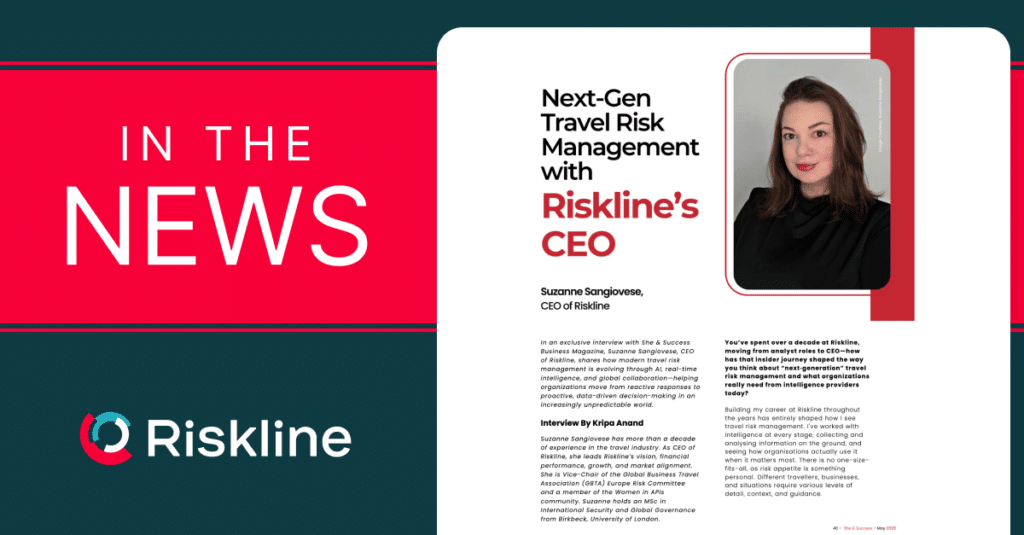
In an exclusive interview with She & Success Business Magazine, Suzanne Sangiovese, CEO of Riskline, shares how modern travel risk management is evolving through AI, real-time intelligence, and global collaboration—helping organizations move from reactive responses to proactive, data-driven decision-making in an increasingly unpredictable world.
Interview By Kripa Anand
Suzanne Sangiovese has more than a decade of experience in the travel industry. As CEO of Riskline, she leads Riskline’s vision, financial performance, growth, and market alignment. She is Vice-Chair of the Global Business Travel Association (GBTA) Europe Risk Committee and a member of the Women in APIs community. Suzanne holds an MSc in International Security and Global Governance from Birkbeck, University of London.
You’ve spent over a decade at Riskline, moving from analyst roles to CEO—how has that insider journey shaped the way you think about “next‑generation” travel risk management and what organizations really need from intelligence providers today?
Building my career at Riskline throughout the years has entirely shaped how I see travel risk management. I’ve worked with intelligence at every stage, collecting and analysing information on the ground, and seeing how organisations actually use it when it matters most. There is no one-size-fits-all, as risk appetite is something personal. Different travellers, businesses, and situations require various levels of detail, context, and guidance.
Organisations today need intelligence that cuts through the noise and avoids overwhelming users with unnecessary information. That means delivering focused, relevant insights that support fast, confident decision-making. “Cutting through the noise” in practice means filtering out irrelevant or low-value data so travellers and travel managers remain informed, prepared and can avoid disruptions. Practically: combining AI, open-source intelligence, and human expertise ensures both speed and context, while providing actionable advice.
Connection and synergy matter too. Risk doesn’t exist in isolation, and neither should intelligence. The key is to achieve integration across industries: travel, insurance, security, and assistance teams working together, with communication to travellers that’s seamless and meaningful.
BCD Travel and Riskline recently announced a strategic partnership to deliver the next generation of travel risk management—can you walk us through what this unified solution actually includes and how it strengthens duty of care and traveler communication across each stage of a trip?
This collaboration brings together BCD’s established travel management and risk technology capabilities with Riskline’s advanced intelligence expertise, creating a unified solution that supports travel and security managers, as well as travelers, with timely, trusted insights when they need it most. BCD’s TRM solution with Riskline’s intelligence solves for this need providing a TRM ecosystem that empowers organizations to communicate effectively and strengthen traveler care across every stage of the journey.
With a shared goal to help organizations prepare and respond more effectively to a complex and fast-moving global risk environment, BCD now leverages Riskline’s modern intelligence suite. A combination of human expertise, AI and open-source intelligence is used to cut through noise and deliver accurate, relevant and actionable risk insights. Drawing from more than 100,000 sources in multiple languages, the joint solution provides unparalleled visibility into global risks. Riskline’s intelligence is seamlessly integrated into BCD’s travel management platform in the form of risk alerts and real-time alerts with emergency response capabilities, transforming intelligence from a specialist input into a core layer of program data, enabling faster, more proactive risk mitigation.
Riskline combines AI, open‑source intelligence and human analysts to monitor more than 100,000 data sources in real time—where do you see AI making the biggest difference over the next decade in detecting emerging risks and cutting through information noise without overwhelming travel managers and travelers?
AI already makes a big impact by helping filter vast amounts of information, so human analysts can focus on what truly matters. AI could further prove its value by evolving from reaction to prediction and personalization.
I see the potential of predictive analytics to help anticipate disruptions, from extreme weather and health outbreaks to political instability, by analysing patterns across multiple data points in real time. This will help shift travel risk management from reactive to proactive.
AI could also personalize travel alerts depending on the recipient. A person who has a diverse profile in terms of sexual orientation, religion or any other identity marker may face different risks even if a location or an incident is marked “low risk” for the average traveler.
AI alone isn’t enough, though. Its real value comes when paired with human expertise. While AI processes data at scale, human analysts provide the context, judgment, and validation needed to ensure accuracy and relevance, especially in a fast-changing world with conflicting information.
The conflict in the Middle East and other fast‑moving crises have highlighted how quickly routes, regulations and security conditions can change—how do partnerships like the one with BCD and tools like real‑time alerts help organizations stay ahead of disruptions rather than simply reacting once incidents occur?
Fast-moving crises show just how quickly travel conditions can change, and why organisations can’t afford to be only reactive. Working with a network of partners helps combine traveller tracking technology, on-the-ground support, insurance and repatriation services with travel risk intelligence to create a unified and comprehensive solution.
For example, when Riskline’s intelligence is built directly into a TMC’s platform, travel managers and travellers receive only relevant real-time alerts and destination insights, making it easier to act before a disruption turns into a crisis. By integrating risk intelligence correctly, organisations can be as prepared as possible and respond faster to keep their travelers safe.
Our reporting on the Middle East crisis is a good example. As flight disruptions or cancellations and airspace closures shifted rapidly, clients didn’t need to track those developments themselves. Riskline analysts created new reports to cover the specific situation in real time and provide this key information to our clients, supporting their operational decision-making and crisis planning.
You’re also one of the relatively few women leading a travel tech and intelligence company, in a sector where most travel managers are women but very few tech leaders are—what does that representation mean to you personally, and how are you working to open more doors for diverse leaders in the travel and risk space?
Representation matters deeply to me. Leading Riskline as a woman is both a responsibility and an opportunity. It allows me to champion inclusion, elevate diverse voices, and show that leadership in this space can and should reflect the people it serves.
On a personal level, it reinforces why thoughtful, empathetic leadership is essential. I’m committed to building an environment where talent is recognised for ability, not limited by gender or background. That means mentoring emerging leaders, advocating for equitable policies, and ensuring diverse perspectives inform decision-making, product design, and risk solutions.
Gender-specific and LGBTQ travel safety considerations are still underserved across the industry, and addressing them is part of how leadership translates into real-world impact. Many of Riskline’s solutions include such information to keep the solo female travelers or LGBTQ community updated on local customs, social acceptance, health and safety in certain locations.
By combining advocacy with action, I aim to open doors for more women and underrepresented leaders in travel risk, helping the industry better reflect its workforce and travellers.
Check out the interview in She & Success Business Magazine.