
LGBTQ travelers are facing a “growing wave of rights rollbacks” globally, according to Riskline’s recently launched 2026 LGBTQ Risk Map, as the support LGBTQ business travelers get from their employers also appears to be on the decline.
Riskline’s map calculates the level of concern for LGBTQ travelers based on such methodology as the legal acceptance of homosexuality and transgender people in a country, social acceptance of LGBTQ individuals and whether same-sex marriage or civil unions are allowed. It sources the data from LGBTQ rights organization ILGA World as well as Equaldex and other LGBTQ organizations.
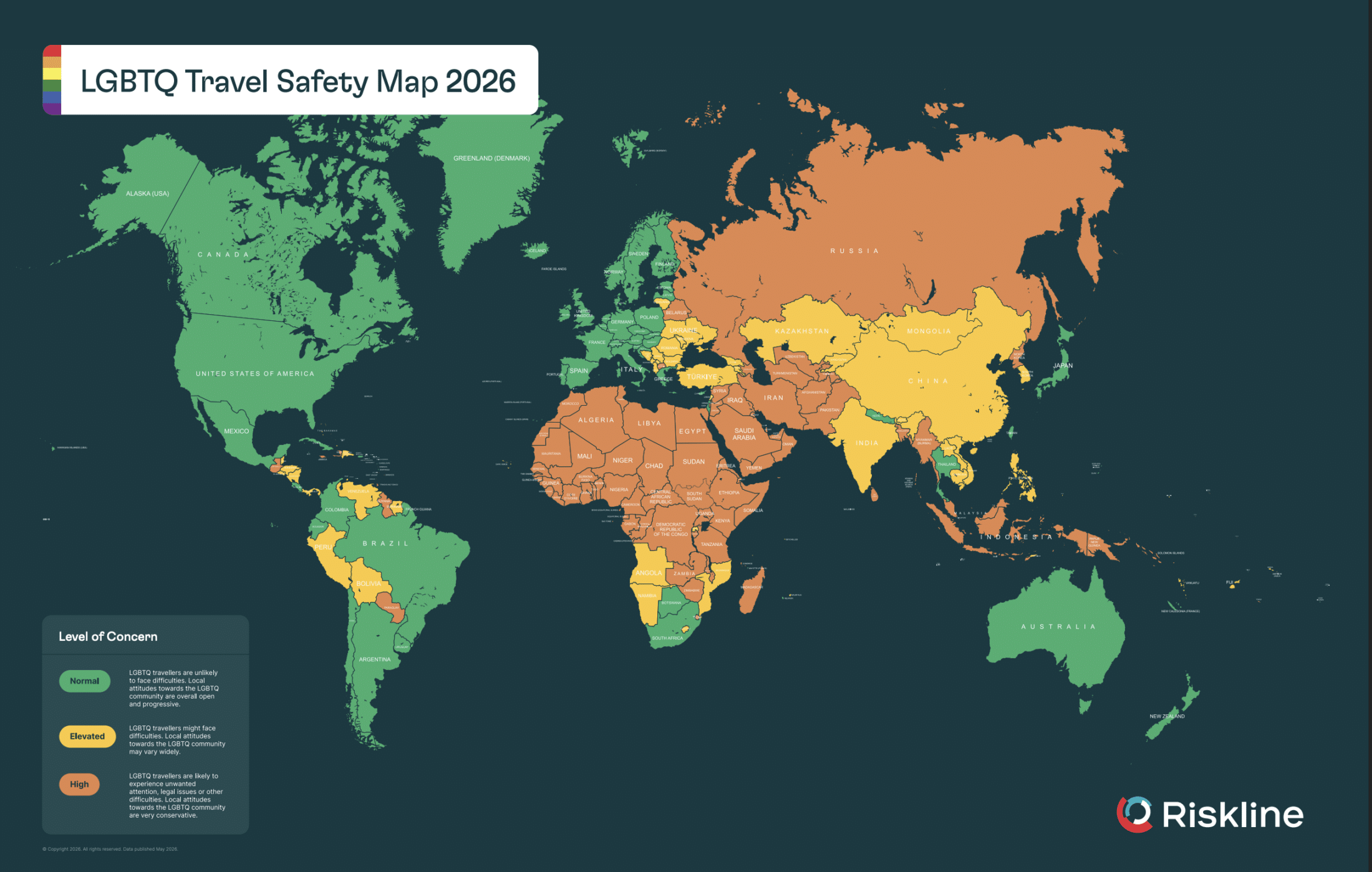
See the full map here.
The overall levels of concern in the map showed little change compared with the 2025 map, with 80 countries rating as the green “normal” safety concern for LGBTQ travelers, 62 rating as yellow “elevated” concern and 91 countries rating as orange “high” concern, indicating LGBTQ travelers to those countries are likely to face unwanted attention, legal issues or other problems. On a regional basis, Western Europe ranked the safest for LGBTQ travelers, with all countries in the green category, while a high percentage of countries in the Middle East, North Africa and Sub-Saharan Africa earned an orange rating.
However, Riskline noted that 10 major legal changes over the past year have skewed more towards restricting, rather than expanding, LGBTQ rights and safety. Only two of those changes were progressive, with the decriminalization of same-sex relations in both Botswana and St. Lucia. The rest involved rollbacks of rights, including criminalization of homosexuality in Burkina Faso, harshening of penalties for same-sex relations in Senegal, “LGBT propaganda” bans in Belarus and Kazakhstan and an adoption ban for same-sex couples in Slovakia. Riskline also noted that India has removed the right for transgender self-identification, and the United States—while still a green destination—was included for its Supreme Court decision upholding the Trump administration’s ban on the “X” gender marker for passports.
Riskline said those changes reflect a need for “dynamic, intelligence-led” risk management for corporate travel that keeps travelers informed of new risks.
“With 67 countries still criminalizing same-sex relations, travel policies should reflect this reality,” Riskline travel intelligence team leader Lorena Peña said in a statement. “For LGBTQ travelers, whether for work or leisure, these figures translate into real legal, cultural and in some cases physical risk.”
In the meantime, a recent survey of 192 corporate travel professionals conducted by Business Travel Show Europe, which is a part of The BTN Group, showed travel policy support for LGBTQ travelers is declining. Only 20 percent of respondents in the survey said their company offered such support, continuing a trend of decline from 22 percent in a 2025 survey and 27 percent in 2024. Only 3 percent of travel managers in the survey said the planned to start supporting LGBTQ travelers in their policy, down from 9 percent in 2025.
The survey indicated support for other minority groups had declined year over year as well, including travelers from marginalized races and ethnicities, neurodivergent travelers and travelers from Orthodox religious groups.
This article was originally published by BTN Europe.