Risk intelligence for travel
When the Middle East conflict erupted at the end of February, I wasn’t surprised. Frustrated, yes. But not surprised.
The world our industry once relied on – predictable disruptions, isolated conflicts, crises we could prepare for – is gone. Ukraine, pandemic-era border chaos, and now a war that impacted over a million travellers in 72 hours. These aren’t anomalies anymore.
Organisational response
What did surprise me was how many organisations were still caught flat-footed. Not because they lacked resources, but because they had quietly assumed the old playbook would hold.
The challenge isn’t just organisational. It’s structural. The travel ecosystem of airlines, insurers, governments, travel management companies, and risk providers operates in silos. In a fast-moving crisis, that fragmentation makes coordinated response difficult, leaving organisations to bridge the gaps themselves.
The consequences were immediate and visible: employees stranded, evacuations slowed, and safety and operational risks heightened. It’s not only people at risk. Physical assets, from hotels to airports to data centres, can also be directly impacted, as recent strikes in the region have shown. While some organisations responded well, the situation revealed a bigger problem: many policies and protocols aren’t built for the fast-moving, complex realities of today’s geopolitical crises.
During recent evacuations, companies with real-time visibility and clear processes were able to respond faster and decisively
Gaps in insurance
Flight cancellations and sudden airspace closures exposed gaps in traditional insurance models. Many standard policies include war-related exclusions, meaning significant disruption costs may not be covered when they’re needed most. At the same time, interest in cancel for any reason (CFAR) coverage has risen in recent weeks, showing a growing demand for more flexible, responsive solutions. CFAR policies come with higher costs and limitations, yes, but they also point to an opportunity for insurers to rethink coverage in a world where disruptions unfold in hours, not weeks.
The crisis also highlighted challenges in operational coordination. Governments issued urgent travel advisories and worked to expand evacuation options, but conditions on the ground changed rapidly as airspace closures and restrictions shifted across the region. In many cases, travellers and organisations were forced to make decisions with incomplete or rapidly evolving information.
In such an environment, adaptability matters. Oman’s Muscat airport emerged as a key evacuation and transit hub, largely because its airspace remained open, and governments and airlines concentrated outbound operations there. What filled the gaps in many cases wasn’t a perfectly coordinated system, but rather a mix of planning, improvisation, and real-time decision-making.
Essential infrastructure
The companies that handled the crisis best share a common approach: they treat travel risk as essential infrastructure, not an afterthought. It’s built into their operations, continuously monitored, and supported by clear processes and accountability, rather than something addressed only when disruption occurs. They integrate real-time intelligence, set clear protocols, and assign responsibilities across teams. Most importantly, they accept disruption as inevitable, not hypothetical.
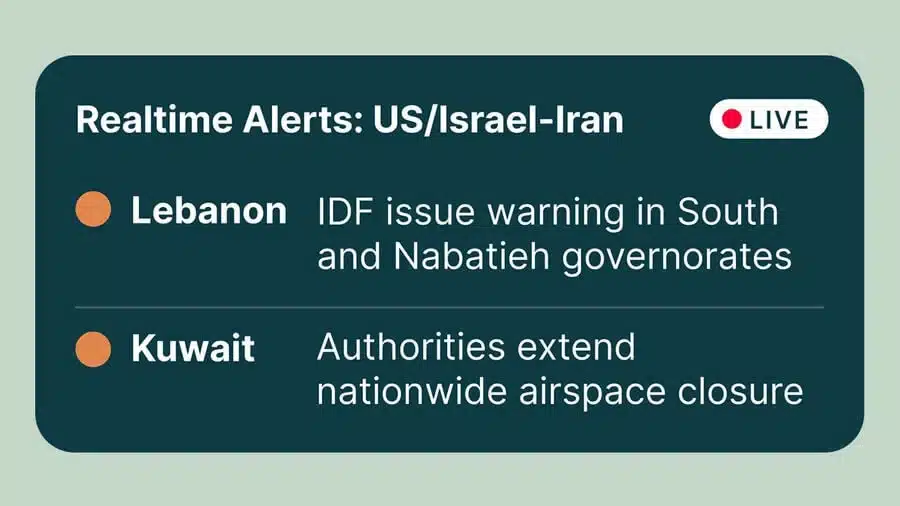
This is where travel risk intelligence proves its value. It’s not a standalone solution, but a key element of every critical travel decision. It helps organisations identify who is at risk, what’s changing, and how urgently they need to act. During recent evacuations, companies with real-time visibility and clear processes were able to respond faster and decisively. Without it, even strong operational plans struggled to keep pace with events.
The lesson isn’t that the industry failed; it’s that it was tested under conditions it isn’t yet fully equipped to handle. As geopolitical disruption becomes the new normal, preparedness must shift from reactive to proactive. In the next crisis, simply knowing what went wrong won’t be enough.
In a world where instability is constant, resilience isn’t about reacting after the fact. It’s about seeing disruption coming, acting with conviction, and protecting people and assets before the situation escalates. So ask yourself: is your company ready to lead when the next crisis hits, or will you be relying on yesterday’s playbook?
By Suzanne Sangiovese, Riskline CEO
The article was originally published in the ITIJ May edition.