
With contributions from Samir Brahimi
Responding effectively to crises is a key part of our work at Riskline. Over the years, we have developed a robust approach for managing official crisis responses. But what exactly do we mean by a “crisis”? While there is no strict definition, it generally requires updating multiple reports, sometimes impacting several countries, and often creates a significant increase in workload compared to our routine operations.
In this article, we focus on the early stages of a crisis and how we manage updates, communication and coordination as events unfold. We also discuss how and when a crisis may conclude or how we handle situations without a clear endpoint.
Types of crises
Crises generally involve exceptional circumstances, often dangerous and typically cause major travel disruptions. From our experience, we tend to encounter three types:
- Slow-build crises, such as the Russia-Ukraine conflict, where developments occur gradually before escalation.
- Breaking-news crises, which require immediate response.
- Preventive scenarios, such as preparatory crisis response documents, for example, in case of a potential Chinese invasion of Taiwan. These documents outline potential actions in advance, allowing us to stay organised and ensure all necessary steps are considered.
Monitoring and initial response
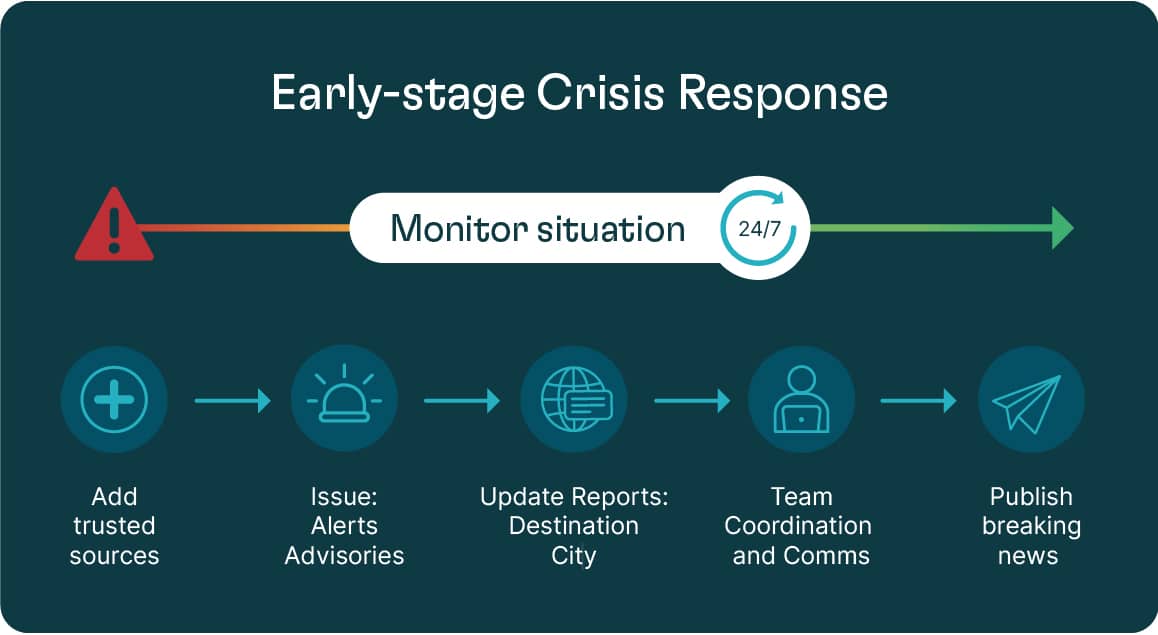
During the early stages of a crisis, our team follows a clear and structured process. We monitor the situation closely, add additional sources, issue alerts and advisories, update City and Destination reports, communicate across teams and, when necessary, publish breaking news updates. For example, in the lead-up to the Iran-Israel conflict in June, advisories were already in place for heightened tensions between the two countries and alerts were being issued for developments in the wider Middle East. Coordination across teams ensured all key developments were tracked without requiring an immediate breaking news report.
After direct fighting between the countries started, we quickly identified additional countries which would likely be impacted by the conflict. We tracked all the developments, including adjustments to risk levels, Destination/City reports and Advisories reflecting the impact in Iran and Israel, as well as the potential impact in countries like Saudi Arabia, the United Arab Emirates, Qatar, Bahrain, Oman, Kuwait and Jordan. The Palestinian territories, Lebanon and Yemen were already being tracked closely due to ongoing fighting with Israel. During the conflict, we maintained consistent monitoring of both Iran and Israel, as well as neighbouring countries, and coordinated with teams handling evacuations, transport disruptions, curfews and other operational impacts.
Managing the end of a crisis
Determining when a crisis ends is context-dependent. Some situations have a clear resolution. This allow us to adjust or remove sources from dedicated channels, tidy communications and return to standard reporting. However, we are often better equipped to respond than to wind down, especially in complex scenarios. Our primary goal is to maintain accurate coverage while ensuring the team stays on track.
Riskline’s approach
Following a structured crisis response process helps us monitor key actions, identify additional steps and maintain overall awareness. It prevents the team from becoming too absorbed in individual alerts, ensuring that we are prepared for client questions and can respond promptly across multiple regions.
This approach has been applied to various situations, from the Ukraine conflict to natural disasters and localised crises like protests in Kenya. Each scenario requires a tailored response, balancing the intensity of tracking with the practicality of report updates.
Our crisis response process has evolved over the years, creating a systematic approach that keeps us timely, accurate and organised. With strong documentation and coordinated teamwork, Riskline excels in real-time crisis response. This is a capability we continue to strengthen.
By understanding the steps to take, monitoring developments carefully and coordinating across teams, we are able to deliver reliable, actionable intelligence during times of heightened risk, helping clients navigate crises with confidence.