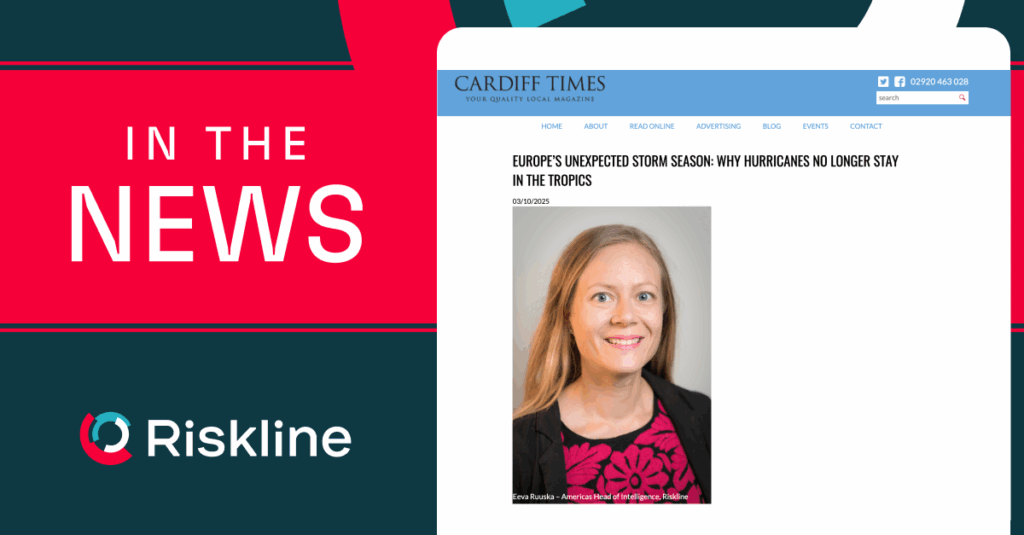
Flying has always meant dealing with the elements. But the elements are shifting. For paragliders and paramotorists, this means a renewed focus on safety, preflight planning, and real-time alerts,” writes Eeva Ruuska, Americas Operations Manager at Riskline
For pilots chasing the perfect thermal or smooth morning glide, the weather has always been both partner and adversary. But over the last few years, nature’s script has begun to shift. From freak wind events over the Alps to sudden microbursts in the Balkans, European skies are becoming increasingly unpredictable. The culprit? A warming planet that is pulling powerful storms far from their traditional haunts and redrawing the map of risk, even for hobby pilots.
Warmer Waters, Stronger Storms
Once the preserve of the tropics, hurricanes and tropical-like systems are making their way into European airspace. It’s no coincidence. Warmer oceans, especially in the North Atlantic and Mediterranean, are now producing the energy these storms need to thrive. In 2024, sea surface temperatures reached record highs in multiple basins, with the Mediterranean heating up 20 percent faster than other seas.
What was once a rare “Medicane” is now a nearly annual event, with systems like Cyclone Daniel leaving swathes of destruction across southern Europe. The contrast between low-pressure systems and cold air intrusions like DANA with the warm air in the Mediterranean favours the generation of “medicanes”, especially between September and October.
As a result, Europe’s storm season is no longer defined by a winter low or a summer squall. We are entering an era where tropical-style storms can form, or at least retain damaging strength, far outside traditional zones.
This is especially concerning for those who live and fly by the weather: paraglider pilots, paramotor enthusiasts, and hang gliders, many of whom have long sought out Europe’s famous microclimates in places like Annecy, Bassano, or Ölüdeniz. These hotspots, once reliable for smooth soaring, are increasingly hit by abrupt downdrafts, unexpected gust fronts, or sheerline winds that seem to come out of nowhere.
What’s Changing, and Why It Matters Now
The mechanics behind this shift are clear. As global sea temperatures rise, an effect supercharged by human-induced climate change, they feed more moisture and energy into the atmosphere. That leads to stronger convection, faster storm intensification, and longer lifespans for cyclonic systems, which can now survive the trip across colder waters into European latitudes.
In fact, according to the World Meteorological Organisation, there’s a 70 percent chance that global temperatures from 2025 to 2029 will exceed 1.5°C above pre-industrial levels. That threshold isn’t just a symbolic line for climate policy; it’s a tipping point beyond which storm behavior fundamentally changes. At these higher baselines, even previously “cooling” phenomena like La Niña are no longer enough to tamp down global heating.
In 2024, Hurricane Kirk reformed over the mid-Atlantic and brought gale-force winds and torrential rains as far north as Brittany. Such occurrences are no longer flukes. There is a growing risk corridor stretching from the Iberian Peninsula to the Adriatic, with early indicators suggesting 2025 could be even more active than last year.
Europe’s New Risk Zones
Several regions are emerging as Europe’s new stormfronts:
- The Western Mediterranean has become a flashpoint, where warm waters and Saharan air masses fuel intense convection.
- Southern France and Northern Italy, beloved for their alpine thermals, are increasingly exposed to severe wind shear events.
- The Balkans, historically sheltered from oceanic systems, now see regular storm spillovers from the Ionian Sea.
- Even Scandinavia has reported unusually strong pressure systems and damaging winds in recent autumns.
For pilots, these changes demand more than an extra glance at Windy or the local METAR. It requires a mindset shift, from expecting seasonal patterns to preparing for chaotic extremes.
What’s Ahead: The Forecast Beyond Forecasting
While forecasting has improved immensely, there are two key challenges: First, storms are intensifying more quickly than before, meaning a safe morning launch can turn perilous by mid-afternoon. Second, the reach of these storms is expanding, making previously “safe” zones susceptible to sudden, severe conditions.
For instance, the Atlantic hurricane season outlook for 2025 forecasts an above active season. The implications don’t end on distant Caribbean shores. Just as transatlantic jetstreams bring smooth lift one day and turbulence the next, so too do the remnants of major storms now swirl into central Europe days after their coastal landfalls.
This isn’t just about more storms, it’s about more intense, less predictable, and geographically surprising ones.
For Pilots, Preparedness Is the New Freedom
Flying has always meant dealing with the elements. But the elements are shifting. For paragliders and paramotorists, this means a renewed focus on safety, preflight planning, and real-time alerts. It means factoring in long-range climate trends when choosing destinations. And it might mean reevaluating once-sacred flying seasons in favour of shoulder months when stability is more likely.
Ultimately, our skies are changing. As they do, pilots, like so many others, will need to adapt, not just to survive but to continue thriving in the air. Understanding the why behind the weather is no longer the domain of scientists alone; it’s becoming part of every pilot’s toolkit.
About Eeva
Eeva joined Riskline in 2018 and has over a decade of combined experience in travel risk management and international development. She holds an MSc in Development Geography and a BSc in Regional Studies from the University of Helsinki. She currently serves as Americas Head of Intelligence at Riskline, where she leads a regional team of analysts to provide political, security and travel intelligence worldwide. Eeva also conducts socio-economic and environmental research projects and business information retrieval on an assignment basis.
Read the full article in Cardiff Times.