In the old world of business travel, risk management was an afterthought – a discreet line item handled in the back office. The priority was simple: get there, complete the work, return home. Disruptions were unusual and typically dramatic, such as political crises, terrorist incidents, or volcanic ash clouds.
That world has changed.
Today, disruption is constant. TravelPerk’s 2024 Business Travel Disruption Report shows that nearly eight in ten business travellers experienced interruptions last year, from climate-driven weather events to cyber outages and geopolitical flare-ups. In the Middle East, these interruptions carry particular weight. The region functions as a hub linking East and West, meaning that a grounded flight in Dubai or Doha sends ripples across global networks.
From niche to necessity
June 2025 illustrated the stakes. Escalating tensions between Israel and Iran closed swathes of regional airspace. Global airline cancellations rose 20 percent in a single month; in the Middle East, they surged nearly 200 percent. Emirates and Qatar Airways were forced to ground or reroute thousands of flights, creating widespread delays at some of the world’s most efficient airports.
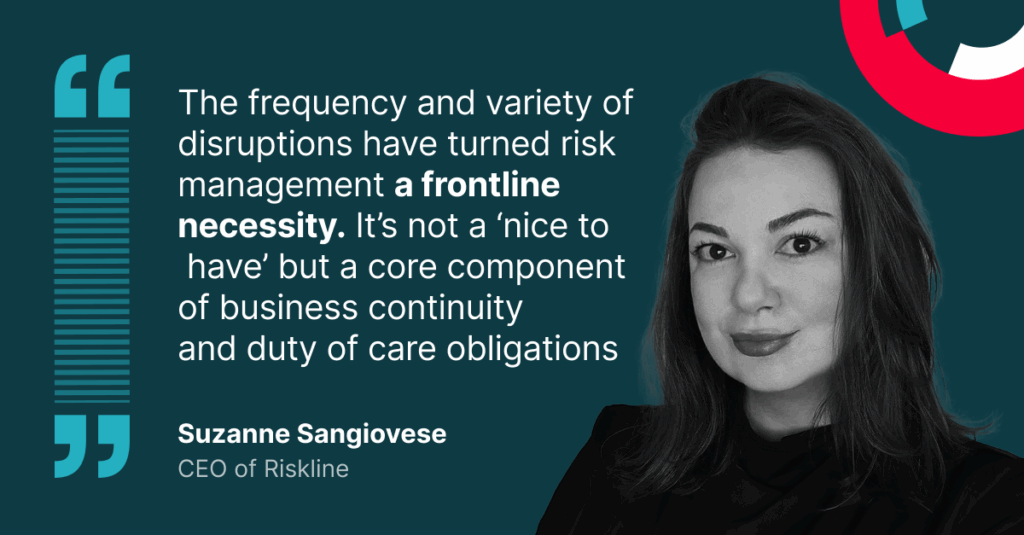
For Suzanne Sangiovese, CEO of travel risk intelligence firm Riskline, this was not a one-off. “In June, we issued nearly 700 alerts for the Middle East, reflecting the scale and urgency of ongoing developments. The frequency and variety of disruptions, such as climate extremes, geopolitical tensions, and outbreaks, have turned risk management a frontline necessity. It’s not a ‘nice to have’ but a core component of business continuity and duty of care obligations. For travel firms in the GCC, having robust risk management systems in place is a competitive advantage. It builds traveller trust, enhances operational resilience, and helps protect revenues.”
Airlines and travel management companies in the Middle East now treat risk intelligence as essential infrastructure. Providers that can alert travellers before problems arise, offer alternatives in real time, and communicate with clarity will keep their customers. Those that cannot will struggle to maintain trust and revenue.
Integration, not add-on
The model is evolving. Risk intelligence is no longer a separate app or buried link. Increasingly, it is embedded directly into booking and travel-management platforms.
As Sangiovese explains: “Our collaboration with ITL World highlights a growing demand for integrated intelligence solutions. Travel providers are seeking tools that can be seamlessly embedded within a unified technology stack. This trend reflects a broader shift across the Middle East towards more proactive and streamlined risk management, making it an inherent part of the travel planning process. These partnerships also illustrate how technology-driven solutions are simplifying travel management in the region, empowering travel companies to adapt in real time and better serve their clients.”
A traveller flying from Riyadh to Dubai to Muscat should be able to use a single platform that confirms flights and hotels, flags an incoming sandstorm or IT outage, and proposes solutions before disruption occurs. In the Gulf’s hub-and-spoke system, where one airport closure can affect half a dozen countries, integration is survival.
The risks you don’t see
Headlines capture visible shocks such as wars or strikes, but many risks in the Middle East are quieter.
Climate is foremost. The UAE’s heaviest rainfall on record in April 2024 flooded parts of Dubai International Airport, grounding nearly 400 flights. Sandstorms have closed runways in Kuwait, and extreme heat continues to test infrastructure.
Cybersecurity is another concern. With airports adopting biometric boarding, cloud-based booking, and automated operations, vulnerabilities to IT failures or cyber-attacks grow.
Operational bottlenecks also loom. Mega-events such as Expo 2020 Dubai, the FIFA World Cup in Qatar, and Saudi Arabia’s expanding calendar of summits and festivals create surges in demand that can strain even the best systems.
A changing traveller
The Middle East’s profile is shifting. High safety standards, luxury amenities, and liberalised visa rules have driven “bleisure” travel and attracted remote workers. New visa schemes for freelancers and digital nomads are expanding.
By 2025 or 2026, the planned unified GCC visa will allow seamless multi-country itineraries across all six Gulf states, similar to Schengen in Europe. Yet this interconnectedness increases fragility: disruption in one hub can quickly affect others.
Religious tourism remains a cornerstone, with millions travelling annually to Saudi Arabia for Hajj and Umrah. Luxury travel is also booming, with over 170 high-end hotels in the Middle East – almost 100 in the UAE alone. Today’s travellers are more tech-savvy, less patient, and expect immediate communication.
As Sangiovese puts it: “Travellers are more risk-aware, but they’re also far less tolerant of disruptions, especially those they perceive as avoidable. According to TravelPerk’s Business Travel Disruption Survey shared in January, 85 percent of global travellers reported a loss of productivity due to disruptions in 2024. We live in a fast-paced, connected world, and digital transparency has raised expectations. With real-time alerts, mobile apps, and social media, travellers expect immediate awareness and swift responses. They’re demanding clearer communication and faster solutions from their travel providers at the very first sign of trouble, minimising these frictions.”
Consolidation, specialisation, and the road to 2030
Behind the scenes, the risk-management sector is consolidating. Large firms are acquiring smaller ones to offer comprehensive solutions, while niche specialists with deep technical or regional expertise succeed when they can integrate with larger systems.
Sangiovese says the picture ahead is clear: “We’re already seeing some consolidation in the travel risk management space, with larger players merging or acquiring others to offer broader service portfolios. At the same time, there’s space and real need for niche providers who offer deep regional expertise or specialisation in areas like cybersecurity, medical evacuation, or high-risk traveller support. Fragmentation only becomes an issue when providers fail to embrace technology. Those that invest in digital maturity and seamless integration will thrive; those that don’t risk falling behind.”
Looking further ahead, she adds: “While 2030 may seem distant, it’s right on our doorstep. A truly risk-resilient travel ecosystem in the Gulf will be seamless, digital and deeply collaborative. It will offer real-time, personalised safety insights, alternative travel options when disruption strikes, and built-in channels for immediate assistance. Governments must lead on infrastructure and policy. Tech firms must drive innovation and transparency. At the same time, travel providers must be responsible for the practical implementation. Risk resilience will only be achieved through shared responsibility and sustained investment in digital tools and climate-adaptive infrastructure.”
The Middle East has built its reputation on being connected – a crossroads for trade, diplomacy, and tourism. In today’s complex environment, that connectivity must be matched with resilience. Success will belong not just to those who react quickly, but to those who anticipate challenges and keep journeys running.
Read the full article in Arabian Business magazine (pages 50-55).