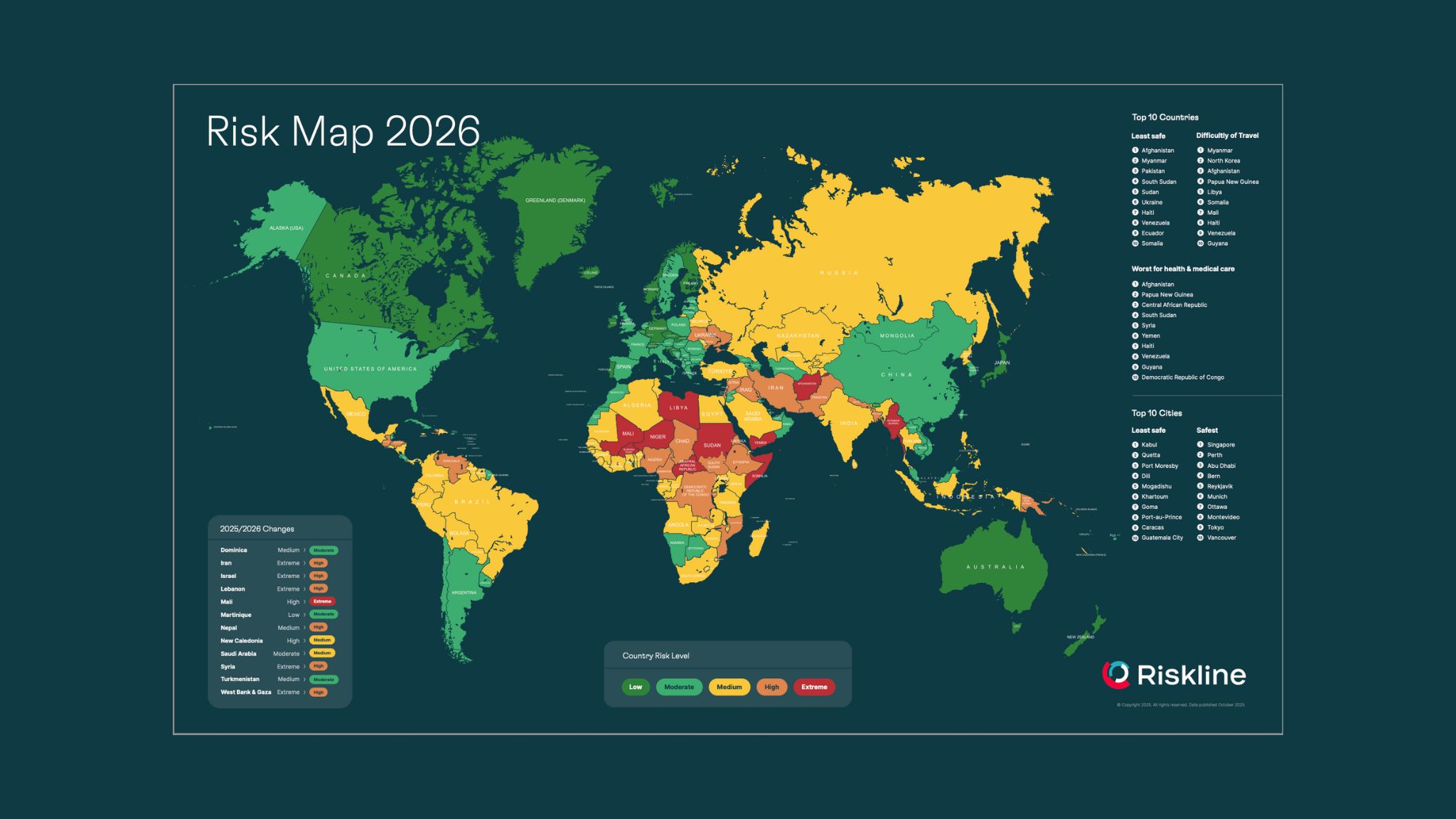
As 2026 approaches, travellers are thinking more critically about the safety of the places they visit. The updated Risk Map 2026, from Riskline and Safeture, highlights global travel risks. It also reveals emerging trends, shifting hotspots and areas of stability. The map gives organisations and travellers the intelligence they need to plan safer journeys.
Here’s a snapshot of what’s changed in the past year and which destinations are safest and most at risk in 2026. Preview and download your 2026 Risk Map here.
Security Trends
Overall, the global security situation remains unstable in many regions. Afghanistan, Myanmar and Pakistan continue to top the list of least safe countries, driven by militant activity, border tensions and weak governance. Sudan, South Sudan, Ukraine, Haiti, Venezuela, Ecuador and Somalia remain at-risk due to ongoing conflict, civil unrest and widespread crime.
Health and Medical Risks
Healthcare systems in many high-risk countries remain fragile as well. Afghanistan is assessed as the worst for medical risk, reflecting the absence of basic infrastructure and limited international support. Papua New Guinea, Central African Republic, South Sudan, Syria, Yemen, Haiti, Venezuela, Guyana and the Democratic Republic of Congo also present significant health risks, including outbreaks of preventable disease, shortages of medical supplies and severely limited access to care where medical evacuation may be necessary in the event of an emergency.
Travel Risks
Some countries continue to pose severe travel challenges. Myanmar, North Korea and Afghanistan are particularly unpredictable, with internal conflict, strict government control and disruptions to public services. Travel to Papua New Guinea, Libya, Somalia, Mali, Haiti, Venezuela and Guyana also carries considerable risk due to crime, poor transport infrastructure and restricted flight access.
Cities: Safest and Least Safe
While some destinations remain perilous, others continue to provide safe environments:
- Safest cities: Singapore, Perth, Abu Dhabi, Bern, Reykjavik, Munich, Ottawa, Montevideo, Tokyo and Vancouver stand out for low crime rates, effective policing and stable governance.
- Least safe cities: Kabul, Quetta, Port Moresby, Dili, Mogadishu, Khartoum, Goma, Port-au-Prince, Caracas and Guatemala City are heavily affected by militant activity, civil unrest and organised crime.
Changes in Country and City Risk Levels
Several countries saw notable shifts in risk over the past year. Israel, Lebanon, Iran and the West Bank and Gaza fluctuated with the Gaza conflict, peaking at extreme in June before lowering to high following ceasefires. Martinique spiked at medium risk during protests before stabilising. New Caledonia improved after unrest ended and Turks and Caicos rose due to crime. Mali, Nepal and Mozambique all saw heightened risk from jihadist attacks, Gen Z protests and post-election unrest, respectively, whereas Congo-Brazzaville and Bangladesh benefited from stabilisation.
Cities mirrored national trends. Beirut, Damascus, Tehran, Tel Aviv and Jerusalem spiked amid regional conflict. Nay Pyi Taw rose to extreme after militia attacks and natural disasters. Seoul increased to moderate during protests, while Acapulco and Los Cabos faced higher risks from cartel violence. Dhaka stabilised, and Jakarta and Kathmandu rose due to youth-led protests.
A Shifting Global Risk Landscape
Armed conflict remains the primary driver of travel risk, with ongoing clashes, insurgencies and civil unrest shaping the world’s most dangerous destinations. The fragility of healthcare infrastructure further compounds these risks, leaving travellers particularly vulnerable in countries such as Afghanistan, South Sudan and Haiti. Yet, pockets of stability endure: cities with strong governance, effective policing and cohesive communities continue to offer reliable safe havens.
Looking ahead, the global risk landscape is likely to remain dynamic, with shifting political tensions, evolving conflict zones and climate-related pressures influencing safety. These interconnected pressures will make travel risk less predictable, highlighting the critical need for real-time intelligence, forward-thinking planning and flexible risk management strategies for both organisations and corporate travellers.