By Diego Maloney
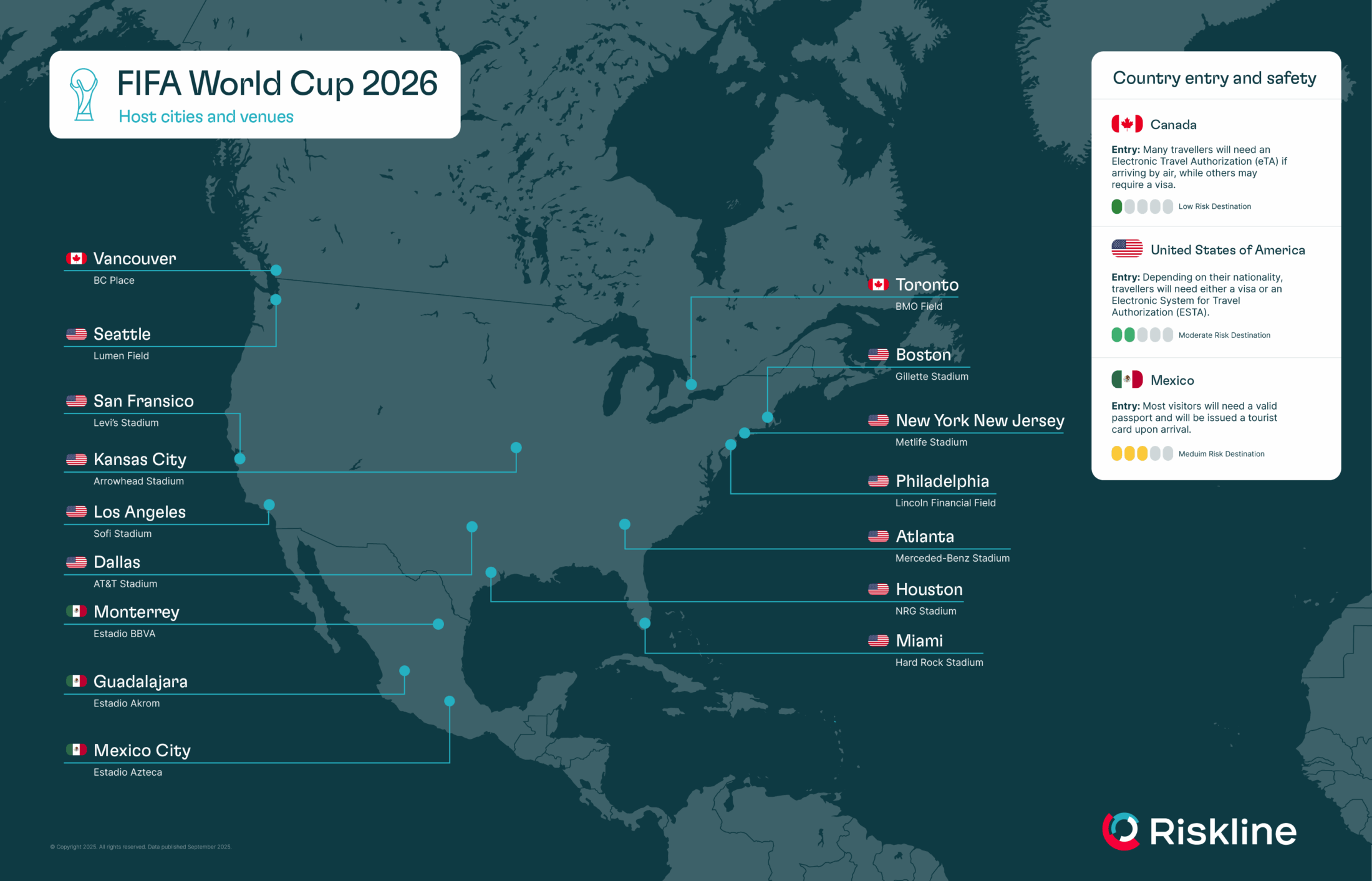
The 2026 FIFA World Cup ticket sales start today! The tournament will bring millions of fans to stadiums across the United States (US), Canada and Mexico. With such a large international event, security will be a top priority. Visitors should be aware of local requirements and best practices for safety in each host country. If you are planning on attending this once-in-a-lifetime global event, here is what we have gathered in terms of practicality and security.
Travel requirements in the US
In the US, travellers will need, depending on their nationality, either a visa or an Electronic System for Travel Authorization (ESTA). Travellers in need of a visa should plan ahead owing to long wait times and begin the visa application process as soon as possible. US border officials are strict, making it important to carry proof of accommodation and onward travel. At stadiums, fans should expect airport-style security including metal detectors, pat-downs and restrictions on bags. Many venues will likely enforce a clear-bag policy. Outside busy urban centres, fan zones and transport hubs, armed robberies can occur in low-income neighbourhoods that are located near areas where visitors will frequent. It is important to take general precautions to avoid wandering into a dangerous area, especially after dark. Petty crimes such as pickpocketing may also occur on public transport, especially during peak times.
Travel requirements in Canada
Entry rules are slightly different in Canada. Many travellers will need an Electronic Travel Authorization (eTA) if arriving by air, while others may require a visa. Crossing the border between Canada and the US may involve long wait times. Fans planning to attend matches in both countries should allow for extra travel time. Stadium security measures will closely mirror those in the US, with restrictions on large bags and thorough screening at entry points. Canadian host cities are generally safe. However, crowded downtown areas and transport hubs can attract opportunistic crime, again pickpocketing in this case. Much like in the US, armed robberies are known to occur in low-income neighbourhoods after dark and should be avoided entirely.
Travel requirements in Mexico
Most visitors will only need a valid passport and will be issued a tourist card upon arrival, which must be presented again when departing. Losing this document can cause delays, so it should be kept secure. Officials may request proof of onward travel, accommodation and sufficient means of subsistence. Security at stadiums will likely include thorough bag checks and pat-downs. While Mexican host cities will have heavily policed fan zones and tourist districts, travellers should still take extra care after dark, avoiding poorly lit streets and sticking to high-traffic areas.
Hailing taxis off the street is discouraged as clandestine taxis and shuttle buses offer their services at inflated prices. Some are known to work with criminals in order to extort tourists in express kidnapping schemes. Travellers should stick to using official taxis and rideshare apps such as Uber. Of the three host countries, Mexico poses the greatest risk to personal safety. This is due to its decades-long conflict with powerful drug cartels. Special caution should be taken in unfamiliar areas as criminal organisations are known to operate in major cities. Opportunistic crime can also occur in areas frequented by tourists, including Centro Histórico in Mexico City.
General safety considerations
Across all three countries, some level of hooligan-related violence is possible as was seen in Miami during the Copa América final in 2024. Avoiding concentrations of security forces will reduce the likelihood of violence to bystanders. Additionally, activist groups will almost certainly use the event’s global media coverage to bring attention to their own causes, especially in the US. These protests may cause travel delays or break out in clashes with police in some cases.
In all, fans should plan to keep digital and paper copies of important travel documents, stay updated through FIFA’s official announcements and consider registering with their home country’s traveller alert programme. With preparation and awareness, visitors can focus on what matters most: experiencing an unforgettable World Cup.