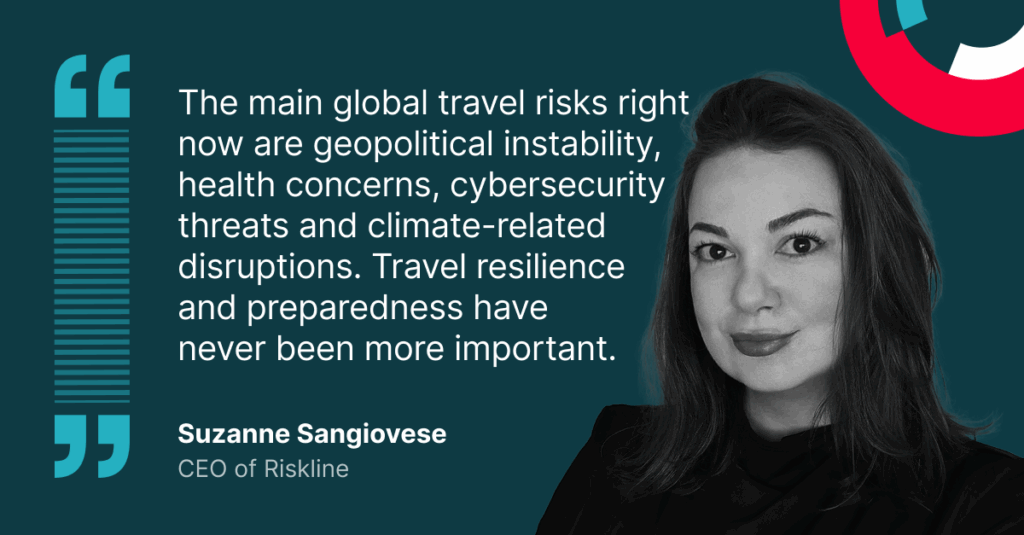
Suzanne Sangiovese, CEO of Riskline, speaks to ITIJ about travel risk management, the biggest issues currently affecting travellers, and her vision for the future of the business
What are your key responsibilities as CEO of Riskline, and are there any projects or initiatives in this role that you’re particularly excited about?
As CEO of Riskline, my core responsibility is to drive the company’s strategic vision, improve financial performance and lead long-term growth initiatives. I’m deeply involved in ensuring we remain aligned with market needs and our customers’ expectations. What excites me most right now is Riskline’s potential for continued innovation and growth, particularly as we expand our services and strengthen strategic partnerships. We are already an industry leader. My focus is on further solidifying our position, leading the team into the next phase of growth and ensuring that Riskline continues to set the standard in travel risk intelligence.
Can you share your background in the industry and what led you to your current position?
I began my journey at Riskline in 2010 as an analyst. Over the years, I’ve had the privilege of working in a variety of roles across different business functions, most recently as Director of Travel and Technology. This broad experience has given me a unique insider perspective on Riskline’s culture and values. It has prepared me to lead the company through a period of high growth and innovation.
Outside of my role at Riskline, I’m deeply engaged in the wider travel and business community. I am the Vice-Chair of the Global Business Travel Association (GBTA) Europe’s Risk Committee, where I help shape industry standards and advocate for best practices. I’m also a member of the Women in Application Programming Interfaces (API) community, which fosters greater diversity and innovation in the tech space.
I actively participate in key industry events such as the Business Travel Show Europe, GBTA Europe and the Nordic Business Travel Associations, where I have the privilege of speaking on emerging trends and the future of risk management. These platforms allow me to contribute to vital conversations around driving innovation and meaningful change within the business travel sector.
Being part of these discussions is important to me, as it enables me to help shape risk intelligence solutions that deliver real and lasting impact for both businesses and travellers worldwide.
How has the travel risk intelligence industry evolved over the past decade, and what have been the biggest driving forces behind these changes?
Over the past decade, the travel risk intelligence industry has shifted significantly in response to how travel itself has changed. Early models of travel risk management, especially those shaped in the post-9/11 era, tended to follow static frameworks that emphasised fixed categories of risk, centrally issued advisories and a one-size-fits-all approach.
Today’s travellers, however, navigate a far more dynamic environment, where risks are fluid, fast-moving and increasingly localised. What we’ve witnessed is a clear shift towards real-time, personalised intelligence. This has been driven by the growing complexity of global travel, rising geopolitical volatility and increasing expectations from organisations responsible for traveller safety.
Technology, particularly the use of APIs, automation and artificial intelligence (AI), has enabled providers to respond with more speed and relevance, delivering risk information that is timely, contextual and often tailored to the individual traveller’s journey.
The industry hasn’t simply matured; it has become more agile. Rather than reacting to events, organisations are now seeking predictive insights and practical, forward-looking guidance. That’s the space we operate in: helping businesses anticipate and respond to risk with clarity and confidence, rather than simply reacting after the fact.
What do you see as the most significant travel risks globally right now?
Right now, the biggest global travel risks fall into a few key categories: geopolitical instability, health concerns, cybersecurity and climate-related disruptions. Conflicts and political unrest are causing sudden changes to travel plans and safety conditions, often with very little warning. At the same time, health risks, from infectious diseases to localised outbreaks, continue to affect where and how people can travel.
Another major risk is digital. Most of the pre-travel experience now happens online: booking, payments and even boarding, making cybersecurity threats such as data breaches and identity theft a growing concern, particularly for frequent travellers and corporate programmes.
And finally, extreme weather events like floods, wildfires and heatwaves are occurring more frequently and with greater intensity. Climate change is no longer just an environmental issue; it’s a travel issue, disrupting infrastructure and operations around the world. These risks are complex, but they all point to the same conclusion: travel resilience and preparedness have never been more important.
Are there any emerging threats in 2025 that travellers and businesses should be particularly aware of?
In 2025, geopolitical volatility remains one of the most pressing threats to global travel. Tighter visa policies and increased scrutiny at borders are being implemented across several regions, leading to more complex entry requirements, delayed processing and potential travel disruptions. These changes can have a significant impact on business travel, where timing and reliability are critical.
Ongoing conflicts in areas such as the Middle East and Eastern Europe are also contributing to global uncertainty. These situations not only pose safety risks but can trigger sudden shifts in border access, flight availability and regulatory conditions.
The key challenge for travellers and businesses alike is the unpredictability of these threats. Staying ahead means being flexible, investing in robust travel risk management tools and prioritising real-time intelligence to adapt quickly to changing circumstances.
How does Riskline help travellers stay informed and prepared for potential risks, both before and during their trips?
Riskline provides timely risk assessments on safety, health, entry requirements and other essential travel information. Before a trip, travellers can access clear, actionable insights to help them prepare with confidence.
During travel, real-time alerts based on location keep them informed of any disruptions or emerging risks, enabling them to adapt quickly and stay safe.
Our intelligence is also embedded directly into the platforms of travel management companies, security providers, assistance firms and insurers, ensuring that travellers receive relevant updates through the tools and services they already use.
What new technologies is Riskline embracing to enhance travel risk management?
AI and data analytics are reshaping travel intelligence by making it faster, more adaptive and relevant. At Riskline, we’re using technologies like machine learning and open-source intelligence to enhance the way we monitor and assess global threats. The broader shift underway is moving from static, reactive alerts to dynamic, predictive insights. The future of travel risk isn’t just about knowing where the danger is; it’s about understanding who it affects and when. This means tailoring intelligence to the traveller’s context, considering factors such as identity, legal exposure and cultural nuance, while ensuring that data is handled with care. The goal is clear: to deliver timely, trustworthy information before risk becomes reality.
How do you see AI and data analytics shaping the future of travel intelligence, and how is Riskline leveraging these advancements?
AI and data analytics will continue to play a pivotal role in shaping the future of travel intelligence. These technologies allow us to provide more proactive, real-time risk assessments, helping businesses and travellers stay ahead of potential threats. At Riskline, we use AI to enhance our forecasting capabilities, predict emerging risks and analyse trends with greater accuracy. This empowers our clients to make smarter, more informed decisions, ensuring they are always prepared for any situation.
Riskline collaborates with a range of partners – what criteria do you use to select them, and how do you ensure these partnerships align with Riskline’s mission and values?
At Riskline, we believe the best travel risk solutions are built through collaboration. We work with a global ecosystem of partners who share our values: trust, openness, innovation and a deep respect for the diversity of today’s travellers. When selecting partners, we seek those who bring complementary expertise, forward-thinking approaches and a shared commitment to delivering accurate, modern and inclusive solutions. Our partnerships are not just transactional; they’re grounded in a shared purpose: empowering travellers with reliable, context-rich intelligence that reflects the complexity of the world they navigate.
Looking ahead, what is your vision for Riskline’s future, and what are the key goals you hope to achieve in the coming years?
Riskline already plays a critical role in helping people and organisations navigate risk with confidence, and my vision is to deepen that impact. We will continue to focus on what we do best: delivering timely, accurate and actionable intelligence. At the same time, we are evolving, expanding the ways in which our data can be used, making our products easier to integrate and forming the right strategic partnerships to extend our reach. The goal is not reinvention; it is refinement. We want to create more value for our customers by being even more relevant, visible and indispensable in the moments that matter.
Suzanne Sangiovese
Suzanne has over a decade of experience in the travel industry, driving the company’s vision, growth and financial performance. She is also the Vice-Chair of the Global Business Travel Association (GBTA) Europe’s Risk Committee and a member of the Women in APIs community.
See the full interview in ITIJ.