




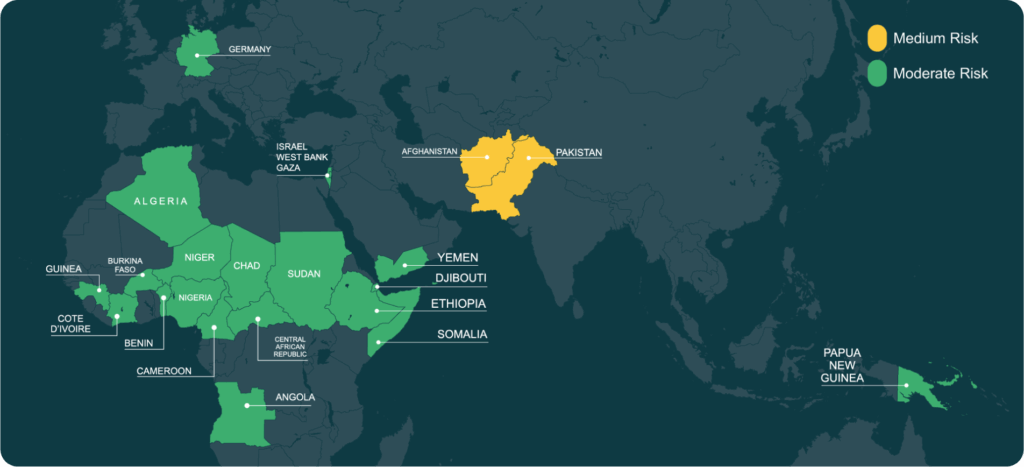
Localised polio outbreaks across multiple countries

Polio outbreaks and travel risk

Localised outbreaks of wild poliovirus (WPV) and circulating vaccine-derived polioviruses (cVDPV) are ongoing across multiple countries. Unvaccinated children and adults are most at risk. Polio spreads via contaminated food, water, or contact with infected faecal matter, causing fever, headache, nausea and, in severe cases, meningitis or paralysis. Paralytic polio has a 15–30% fatality rate in adults.

Polio remains endemic in Afghanistan and Pakistan, while cVDPV2 cases have been reported in several countries, including Yemen, Ethiopia, Papua New Guinea, Nigeria, Chad and Angola. Environmental detections have occurred in Algeria, Gaza, Israel, Germany and other locations.

Travellers should ensure full vaccination, follow local health guidance and exercise caution, especially in conflict-affected areas with limited healthcare.
Travel

Impact on Travel:
Government officials might require inbound and outbound travellers to show proof of polio vaccination on their International Certificate of Vaccination or Prophylaxis (ICVP) yellow card. From 10 January 2025, Saudi Arabia requires travellers from countries with polio cases, including Pakistan, Afghanistan and several African nations, to show proof of polio vaccination on their ICVP (“yellow card”). Other countries currently have no travel restrictions.

Advice:

Travellers should be fully vaccinated against poliovirus before visiting areas with confirmed cases. They should maintain good hygiene, drink safe water and eat properly prepared food. Travellers should also monitor their health after travel and seek medical attention immediately if exposed or if symptoms develop.

Disclaimer

This is a summary of our Advisories. The full version provides a detailed analysis, additional insights and the context for each incident. You can view a sample here.

Request a demo to see our Advisories in action.

Destinations Impacted 

Medium risk countries: Afghanistan, Pakistan

Moderate risk countries: Algeria; Angola; Benin; Burkina Faso; Cameroon; Central African Republic; Chad; Côte d’Ivoire; Djibouti; Ethiopia; Germany; Guinea; Israel; Niger; Nigeria; Papua New Guinea; Somalia; Sudan; West Bank and Gaza; Yemen

Risk Levels

Safe, with few security risks. Travel disruptions: travel is possible with an expectation of routine disruptions and delays.

Generally safe, with some predictable security risks. Travel disruptions: travel is possible with an expectation of routine disruptions and delays.
Not completely safe, but typically presents predictable security risks. Travel disruptions: travel is possible, but there is a potential for disruptions.
Can be dangerous and may present unexpected security risks. Travel disruptions: travel is possible, but there is a potential for severe or widespread disruptions.
Extremely dangerous and presents unpredictable security risks. Travel disruptions: chaotic; travel impossible.

Destination Research

Destination risk, safety & travel reports

Travel Search

Visa, health, safety & documentation

TripReady

Pre-travel security & travel safety advisories

Realtime Alerts

Breaking on-site travel risk updates 24/7

Visa Check Beta Tool

Instant, accurate visa rules for 220+ countries

Travel and Tech Data

Data to improve user satisfaction

Technology Solutions

APIs, widgets and portal

The Informer

Articles, news and product updates

Newsroom

The latest developments at Riskline

Resources

In-depth content on relevant topics

Download the PDF