




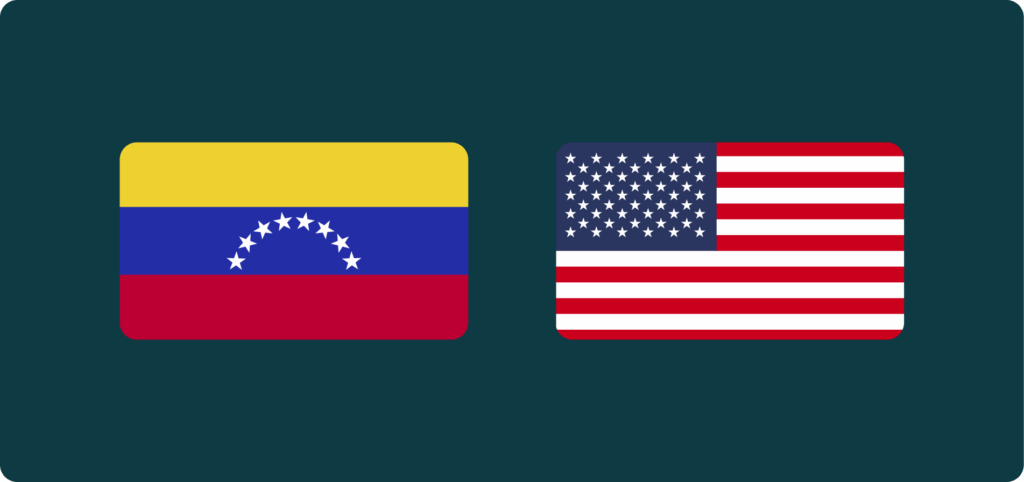
Heightened tensions between Venezuela and the U.S.

US-Venezuela military tensions

Early on 3 January, the US launched multiple airstrikes on Caracas. Hours later, President Trump announced that US special forces had captured President Maduro and First Lady Cilia Flores. They were flown out of Venezuela to face narcotrafficking charges in the US. At least 40 Venezuelans, including soldiers and civilians, were killed and dozens more were wounded during the fighting.

In August 2025, the US initiated a military build-up in the waters off the Venezuelan coast. Trump deployed multiple warships to intercept alleged Venezuelan drug shipments to the US. Since then, several more warships, including an aircraft carrier strike group, have also been deployed. The US has conducted multiple drone strikes targeting said vessels in the southern Caribbean Sea and in the Eastern Pacific.

What to Expect: 

Following the capture of Maduro, the Supreme Tribunal of Justice appointed Vice President Delcy Rodriguez acting president. The role the security services play going forward will be key and a military takeover cannot be ruled out. Whether or not the sudden removal of Maduro will represent the collapse of the regime remains to be seen.

The US bombings were immediately followed by a rush on stores and petrol stations to stock up on essential goods. However, no large-scale protests against the regime have taken place, nor have any top officials publicly defected. The ruling United Socialist Party of Venezuela (PSUV) maintains a firm grip on the country’s institutions and retains the support of the police and military under a model of governance in which corruption is deeply entrenched.

Rodriguez appeared on state TV hours after Maduro’s capture alongside the commanders of the police and military to declare that he legally remains president even in his absence and she vowed not to cooperate with the US. Trump has downplayed the idea of Venezuela’s opposition leaders playing a major role in any further political settlement but also threatened to resume hostilities if Venezuela does not cooperate with the US on a host of issues including migration, drug interdiction and oil revenues. Further US military action could prompt the remaining leadership to either resign and flee en masse or attempt to grab power for themselves.
Travel

Impact on Travel: 

As of 21 November 2025, US aviation authorities issued a Notice to Airmen (NOTAM) for Maiquetía Flight Information Region (SVZM), which covers all of Venezuela and a large part of southern Caribbean, effective through 19 February, urging operators to exercise caution at all altitudes and airports due to the worsening security situation and heightened military activity. Multiple airlines have since suspended operations or cancelled flights at Caracas Simón Bolívar International Airport (CCS/SVMI). Spanish aviation authorities extended a NOTAM for <strong>Maiquetía Flight Information Region (SVZM) until 31 January, strongly advising operators not to conduct flights in the airspace. The airlines affected by the measure include Iberia, TAP, Avianca, LATAM, Turkish Airlines, GOL, Plus Ultra and Air Europa.

President Maduro declared a nationwide state of emergency which remains in effect. The US Embassy in Bogota, Colombia, issued a nationwide shelter-in-place order for US citizens living in Venezuela, while Colombian President Gustavo Petro announced that heightened security measures were implemented along the border with Venezuela.

Advice: &lt;/span></p></p></span>

  • Defer non-essential travel to Venezuela.
  • le=”font-weight: 400;” aria-level=”</yoastmark”>”1″>Avoid all border and coastal areas in the <strong>southern Caribbean.</l

i

>

      • aria-level=”1″>Avoid loitering near security forces, including military installations, and government infrastructure.

    <li

style=”font-weight: 400;” aria-level=”1″>The

&lt;strong>US Embassy</stron

g> in Caracas is closed to the public. In the event of hostilities, US nationals in Venezuela are at risk of detention.

  • Anticipate possible airspace closur

es and disruptions to flight schedules; contact booking agents for updates.


Disclaimer

This is a summary of our Advisories. The full version provides a detailed analysis, additional insights and the context for each incident. You can view a sample here.

Request a demo to see our Advisories in action.

Destinations Impacted 

Venezuela

Risk Levels

Safe, with few security risks. Travel disruptions: travel is possible with an expectation of routine disruptions and delays.

Generally safe, with some predictable security risks. Travel disruptions: travel is possible with an expectation of routine disruptions and delays.
Not completely safe, but typically presents predictable security risks. Travel disruptions: travel is possible, but there is a potential for disruptions.
Can be dangerous and may present unexpected security risks. Travel disruptions: travel is possible, but there is a potential for severe or widespread disruptions.
Extremely dangerous and presents unpredictable security risks. Travel disruptions: chaotic; travel impossible.

Destination Research

Destination risk, safety & travel reports

Travel Search

Visa, health, safety & documentation

TripReady

Pre-travel security & travel safety advisories

Realtime Alerts

Breaking on-site travel risk updates 24/7

Visa Check Beta Tool

Instant, accurate visa rules for 220+ countries

Travel and Tech Data

Data to improve user satisfaction

Technology Solutions

APIs, widgets and portal

The Informer

Articles, news and product updates

Newsroom

The latest developments at Riskline

Resources

In-depth content on relevant topics

Download the PDF