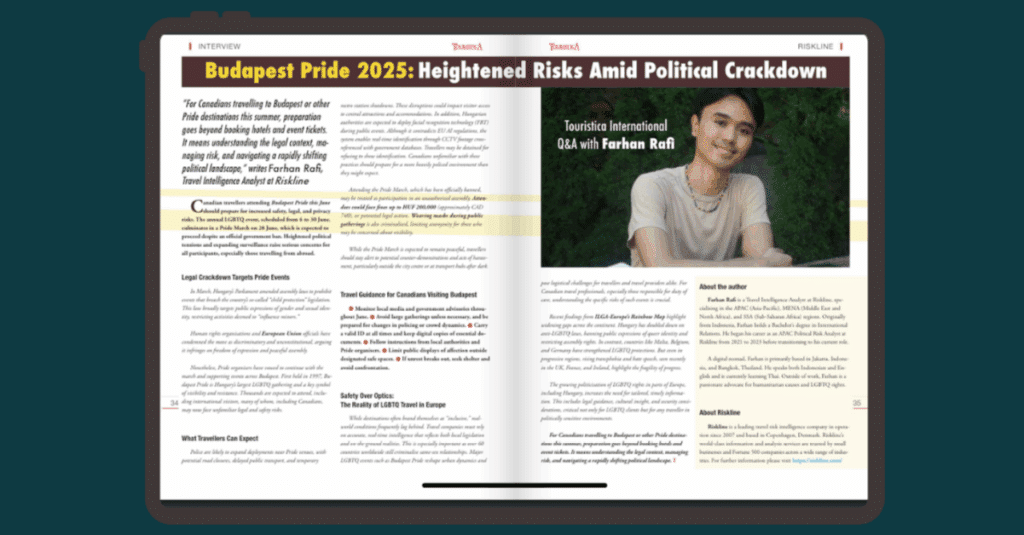
“For Canadians travelling to Budapest or other Pride destinations this summer, preparation goes beyond booking hotels and event tickets. It means understanding the legal context, managing risk, and navigating a rapidly shifting political landscape,” writes Farhan Rafi, Travel Intelligence Analyst at Riskline.
Canadian travellers attending Budapest Pride this June should prepare for increased safety, legal, and privacy risks. The annual LGBTQ event, scheduled from 6 to 30 June, culminates in a Pride March on 28 June, which is expected to proceed despite an official government ban. Heightened political tensions and expanding surveillance raise serious concerns for all participants, especially those travelling from abroad.
Legal Crackdown Targets Pride Events
In March, Hungary’s Parliament amended assembly laws to prohibit events that breach the country’s so-called “child protection” legislation. This law broadly targets public expressions of gender and sexual identity, restricting activities deemed to “influence minors.”
Human rights organizations and European Union officials have condemned the move as discriminatory and unconstitutional, arguing it infringes on freedom of expression and peaceful assembly.
Nonetheless, Pride organizers have vowed to continue with the march and supporting events across Budapest. First held in 1997, Budapest Pride is Hungary’s largest LGBTQ gathering and a key symbol of visibility and resistance. Thousands are expected to attend, including international visitors, many of whom, including Canadians, may not face familiar legal and safety risks.
What Travellers Can Expect
Police are likely to expand deployments near Pride venues, with potential road closures, delayed public transport, and temporary metro station shutdowns. These disruptions will impact visitor access to central attractions and accommodations. In addition, Hungarian authorities are expected to deploy facial recognition technology (FRT) during the events. Although in contrast with EU data privacy rules, system enable real-time identification through CCTV footage cross-referenced with government databases. Travellers may be detained for refusing to show identification. Canadians unfamiliar with these practices should prepare for a more heavily policed environment than they might expect.
Attending the Pride March, which has been officially banned, may be treated as participation in an unauthorized assembly. Attendees could face fines up to HUF 200,000 (approximately CAD 740), or potential legal action. Wearing masks during public gatherings is also criminalized, limiting anonymity for those who may be concerned about visibility.
While the Pride March is expected to remain peaceful, travellers should stay alert to potential counter-demonstrations and acts of harassment, particularly outside the city centre or at transport hubs after dark.
Travel Guidance for Canadians Visiting Budapest
-
Monitor local media and government advisories throughout June.
-
Avoid large gatherings unless necessary, and be prepared for changes in policing or crowd dynamics.
-
Carry a valid ID at all times and keep digital copies of essential documents.
-
Follow instructions from local authorities and police.
-
Limit public displays of affection outside designated safe spaces.
-
If unrest breaks out, seek shelter and avoid confrontation.
Safety Over Optics: The Reality of LGBTQ Travel in Europe
While destinations often brand themselves as “inclusive,” real-world conditions frequently lag behind. Travel companies may want an accurate, real-time intelligence that reflects both local legislation and on-the-ground realities. This is especially important as over 60 countries worldwide still criminalize same-sex relationships. Major LGBTQ events such as Budapest Pride reshape urban dynamics and pose logistical challenges for travellers and travel providers alike. For Canadian professionals, especially those responsible for duty of care, understanding the specific risks of each event is crucial.
Recent findings from ILGA-Europe’s Rainbow Map highlight swelling gaps in protection. Hungary has doubled down on anti-LGBTQ laws, banning public expression of queer identity and restricting community rights. In contrast, countries like Malta, Belgium, and Germany have strengthened LGBTQ protections. But even as progressive regions, rising transphobia and hate speech, seen recently in the UK, France, and Ireland, highlight the fragility of progress.
The growing politicisation of LGBTQ rights in parts of Europe, including Hungary, increases the need for tailored, timely information. This includes legal guidance, cultural insight and security consultation, critical not just for LGBTQ clients but for any traveller in sensitive restrictive environments.
See the full article in Touristica International (pages 34-35).