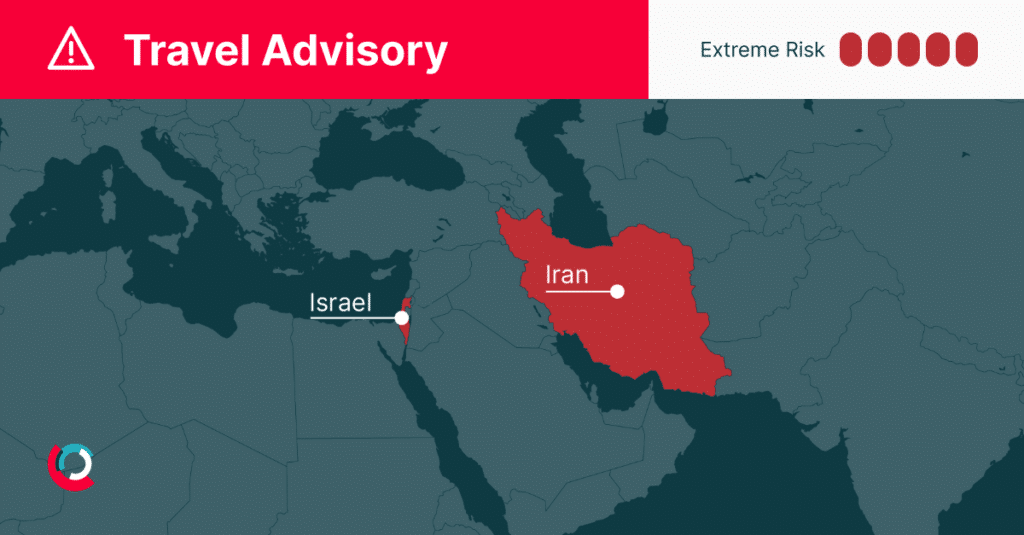
On 28 February, a major regional escalation unfolded following coordinated United States–Israeli strikes on Iran and retaliatory Iranian missile and drone launches toward Israel and US military bases across the Middle East. Non-essential travel to Iran and Israel should be deferred in the near term. Both countries are currently assessed at Extreme risk.This escalation follows the June 2025 confrontation, when the US-Israel alliance launched Operation Rising Lion against Iranian military and nuclear assets. Although a US-brokered ceasefire came into effect on 24 June 2025, tensions persisted amid stalled indirect nuclear talks between Iran and the US and an increasing US military presence in the region.
Situation overview
At around 09:45 Tehran time on 28 February, coordinated US-Israeli airstrikes targeted multiple government facilities across Iran, including Tehran, Isfahan, Karaj, Qom and Kermanshah. Multiple waves of strikes over the past 48+ hours resulted in at least 555 fatalities and hundreds of injuries. Among those killed was Supreme Leader Ali Khamenei, as well as over 40 other senior officials. Telecommunications and internet services were disrupted nationwide and widespread cyberattacks targeted local media and communications infrastructure.
In retaliation, Iran launched ballistic missiles and drones toward Israel, striking Tel Aviv, Haifa and Beit Shemesh, among others. Iran also targeted US military bases across the region, including in the United Arab Emirates, Bahrain, Kuwait, Qatar and Saudi Arabia. Explosions were reported in multiple regional capitals, prompting airspace closures and shelter-in-place orders.
The broader regional environment remains highly unstable, with further hostilities considered probable in the coming days. In the event of sustained confrontation, asymmetric actions, including further threats to maritime traffic through the Strait of Hormuz and proxy attacks from Lebanon, Yemen, Iraq and Syria, remain likely.
Security conditions
The airspace across both Iran and Israel is closed until further notice. Commercial aviation across the Middle East is heavily disrupted, with widespread cancellations and rerouting.
Authorities in Tehran have advised residents to leave the capital, triggering significant traffic congestion. In Israel, emergency measures include shelter-in-place orders and restrictions on non-essential movement.
Cyber operations are intensifying alongside conventional military activity, with disruptions reported across several Iranian media outlets. Iranian authorities have also increased digital surveillance and restricted internet access.
There is an ongoing risk of government-sponsored protests in Iran targeting Western diplomatic or commercial interests, including the Embassy of Switzerland (which represents US interests in Iran) and the Embassy of the United Kingdom. Both have withdrawn staff due to the conflict. Anti- and pro-government protests were also highly likely across Iran in the near term amid internal political polarisation, especially following the death of Supreme Leader Ali Khamenei.
What to expect
- Continued missile and drone exchanges between Iran and US-Israel.
- Additional strikes on US-linked targets in the region, particularly across the Gulf States.
- Active and intensified involvement from Iran’s proxies – “Axis of Resistance”, especially targeting US and allied interests across the region.
- Further regional airspace closures and aviation disruptions.
- Cyber disruptions affecting communications, banking and online services.
- Possible maritime security incidents in the Strait of Hormuz and the Red Sea.
Travel guidance
- Defer non-essential travel to Iran and Israel.
- Review and update evacuation plans immediately.
- Monitor official advisories and notify your embassy of travel plans.
- Avoid all demonstrations and government or military sites.
- Exercise heightened caution near embassies and foreign-owned businesses.
- Seek reinforced shelter immediately in the event of airstrikes.
- Prepare for sudden travel restrictions, curfews or border delays.
- Secure offline access to key contacts and documentation in case of communications outages.
- Evacuation options may be limited due to the rapidly evolving security environment.
Our response: Real-time monitoring
Our analysts worked around the clock to deliver clear, timely intelligence as the situation unfolded.
Rapid alerts: 320 alerts issued since the first strikes on Iran.
Verified intelligence: a regional travel advisory issued for Iran and Israel about the conflict, and individual travel advisories for the United Arab Emirates, Qatar, Bahrain, Kuwait, Saudi Arabia, Jordan and Cyprus for its impact in those countries. Cross-checked reports from local authorities, media and eyewitness accounts to assess threat levels.
Our commitment to excellence
“Our team is closely monitoring developments in Iran, Israel and the wider region in real time. We provide verified, location-specific intelligence across airspace, cyber and ground security domains to support informed travel and operational decision-making in an increasingly complex and shifting security landscape in the Middle East”.
Roxana Dumitrescu, Analyst at Riskline
Riskline continues to monitor developments in real time and provide verified risk intelligence to support informed decision-making through:
- Real-time alerts
- Advisories
- Country reports
- City reports
All information is available via the Riskline APIs and the Portal.
If you would like to utilise any of these services to support your operations and business continuity with credible, trusted information, please feel free to get in touch.