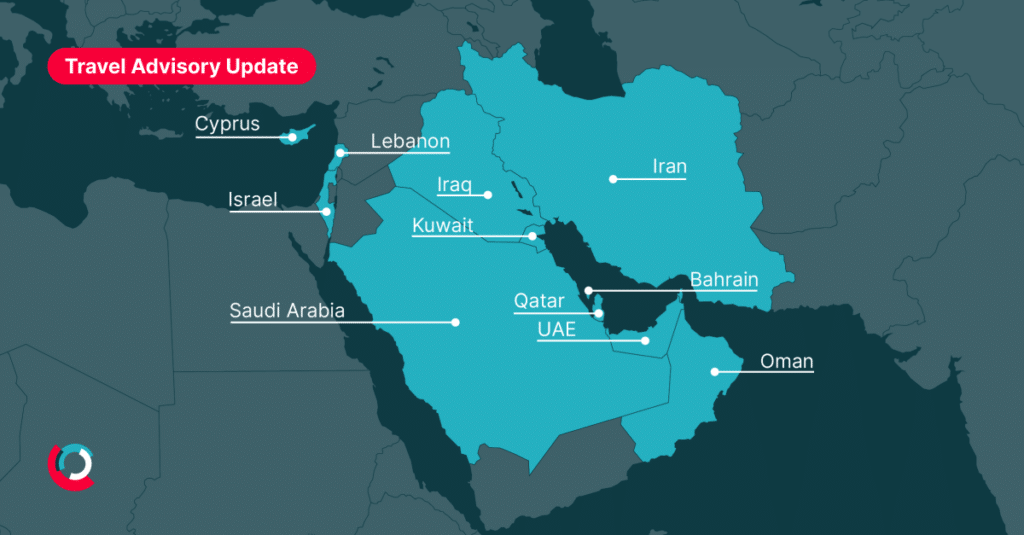
Commercial aviation disruptions across the Middle East are intensifying following coordinated United States-Israeli strikes on Iran and subsequent Iranian retaliation. The region accounted for nearly 10 per cent of global air traffic last year.
Airspace closures across the Persian Gulf region, limited reopening in Israel, repatriation operations and widening regional security risks are reshaping the aviation landscape across Europe, Asia-Pacific and North America.
Non-essential travel to Israel and the affected Gulf states should be deferred in the near term.
Situation overview
On 28 February, the United States and Israel launched coordinated strikes on Iran under Operation Epic Fury / Lion’s Roar. Iran responded by launching missile and drone attacks targeting Israel and US-linked assets across the region.
As a result:
- More than 11,000 flights have been grounded, affecting approximately 1.5 million passengers.
- Airspace is closed in Iran, Israel, Qatar, Bahrain, Kuwait, Iraq and Syria.
- Airspace is partially closed in the UAE.
- Saudi Arabia, Oman, Jordan, Lebanon and Egypt are experiencing significant flight disruptions.
- Global carriers across Europe, Asia-Pacific, North America and Africa have suspended or rerouted services.
Operations at Ben Gurion International Airport, Israel’s main international gateway, are expected to resume in an extremely limited format, primarily to facilitate repatriation.
Repatriation operations
Israeli carriers are preparing rescue flights once airspace permissions allow:
- El Al planning phased return flights from the United States, Thailand and multiple European cities
- Arkia operating rescue routes via Taba (Egypt border crossing)
- Israir arranging return flights via Taba from several European destinations
- Air Haifa preparing operations from Cyprus and Greece once approvals are granted
Travellers may be contacted directly by airlines to register for rescue flights. Capacity is limited and subject to rapid change.
Security conditions
Airspace and aviation
Major regional carriers impacted include:
- Emirates
- Etihad Airways
- Qatar Airways
- Kuwait Airways
- Gulf Air
- flydubai
Flight suspensions and rerouting are also affecting major international operators, including:
- Lufthansa
- British Airways
- Singapore Airlines
- United Airlines
United Arab Emirates
The UAE remains at heightened risk following Iranian retaliation targeting US-linked assets. Previous periods of escalation have included drone and missile threats near:
- Dubai International Airport (DXB/OMDB)
- Abu Dhabi International Airport (AUH/OMAA)
- Strategic infrastructure and energy assets
Limited repatriation flights have resumed via flydubai, Emirates and Etihad Airways. Travellers should not proceed to airports without confirmed departure times.
Land evacuation via Oman and Saudi Arabia is being used by some stranded passengers.
Lebanon and Eastern Mediterranean
Explosions were reported in Beirut as Israeli forces struck alleged Hezbollah sites nationwide.
Evacuation orders have been issued across multiple areas, and operations at Beirut Rafic Hariri International Airport are affected.
This is now both an aviation and ground security crisis environment.
Cyprus is feeling a secondary impact due to its proximity and role as a regional transit and contingency hub, and as a host of United Kingdom military bases.
Further escalation could quickly affect aviation in the Eastern Mediterranean.
What to expect
- Continued missile and drone exchanges.
- Additional short-notice airspace closures.
- Expanded aviation rerouting between Europe and Asia.
- Cyber disruptions affecting communications and infrastructure.
- Potential maritime security incidents in the Gulf.
Travel guidance
- Defer non-essential travel to Israel and affected Gulf countries.
- Exercise caution for travel to the wider Middle East region.
- Confirm flight status directly with airlines before proceeding to airports.
- Review evacuation and contingency plans.
- Monitor embassy advisories and register travel where appropriate.
- Prepare for sudden curfews, movement restrictions or communications disruptions.
- Secure offline access to travel documents and emergency contacts.