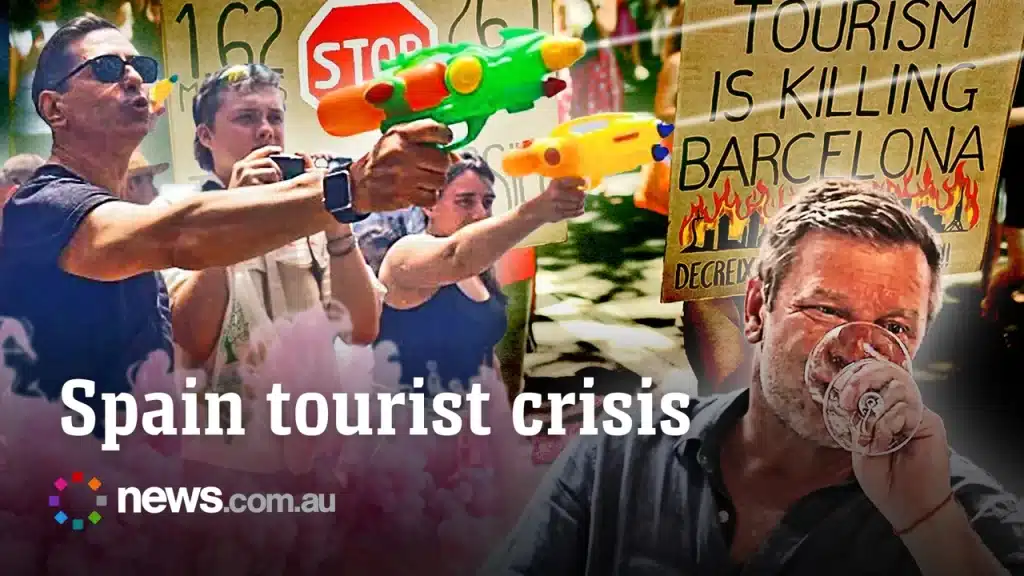
Most of us associate tourism with a good time, but our desire to visit the world’s most famous spots is at the centre of a crisis gripping southern and western Europe.
“Attitudes towards tourism are shifting across Europe,” says Claudia Gualdi from Denmark-based travel data and analyst company Riskline.
Popular holiday destinations across the continent are facing a complex and challenging task: balancing economic reliance on visitors with the pressures of mass tourism.
“The Greek island of Zakynthos, for example, recorded nearly 149,887 tourists per 1000 residents, making it one of the most crowded spots in Europe,” Ms Gualdi, who is the leader of Riskline’s travel intelligence data team, told news.com.au.
“Barcelona, with 1.6 million residents, receives approximately 32 million visitors annually, amplifying existing pressures on housing, infrastructure, and daily life.
“Beyond the sheer numbers, locals are increasingly linking tourism to climate pressures, resource shortages and the strain of everyday life.”
As tensions rise, frustrated locals are telling tourists to go home (with signs, megaphones and water guns) — but the fix is not that simple.
And that is because of how “deeply entrenched” tourism is in local economies, Ms Gualdi explained. She referred to data that found guest nights in the EU’s ten most visited cities increased by more than 200 million between 2021 and 2023.
In efforts across the world to make tourism more sustainable, there have been new taxes and fees introduced, caps put on visitor numbers, and bans on new hotels and short-term rentals.
“A change is possible, but it won’t be fast or easily visible,” Ms Gualdi said.
“It is tied to local governance, EU policies across tourism and hospitality, and ultimately, to how societies themselves redefine what sustainable tourism means.”
It is believed new generations will drive demand for more responsible, balanced tourism models.
However, Ms Gualdi said, even with tourists themselves responding to overcrowding and local pushback by changing their travel patterns — opting for lesser-known destinations or off-season trips — some destinations will likely never experience the “de-touristification” that locals are calling for.
“Iconic locations such as Rome, Paris, Venice, the Greek islands, Santiago de Compostela and the Vatican are unlikely to see reduced demand,” she said.
“Their cultural, religious and historical significance ensures a steady stream of visitors, regardless of broader shifts in travel behaviour.
“These places will continue to face the greatest pressures, highlighting the need for stronger local management and sustainable tourism policies alongside changing traveller habits.”
Europe isn’t the only part of the world struggling to balance its reliance on tourism and the negative impacts of too many visitors in so few areas.
Australians’ favourite Asian destinations, Japan and Indonesia, have urged tourists to explore beyond the hotspots, stressing the importance of dispersing tourism as visitor numbers reach record highs.
But Ms Gualdi believes it is Europe that has become the focal point of headline-grabbing anti-tourism protests “largely because of its density, accessibility, and political environment”.
“Major European cities not only serve as key destinations but also as hubs for global transit, which means they experience a constant high turnover of visitors,” she explained.
“This accelerates ‘wear and tear’ on infrastructure and amplifies resident frustration.
“Europe’s strong media presence, active local movements, and governance frameworks at both city and EU level also create an environment where residents can push back more vocally and visibly compared to other destinations.”
Ms Gualdi believes there was not a particular turning point in these destinations — that long ago built reputations as welcoming hubs for visitors — but rather “repeated shocks” that added strain on housing, price and infrastructure, and have “changed the balance between tourism as an economic engine and tourism as a social and environmental stressor”. Such shocks include the Olympic Games, the Great Recession and the Covid pandemic.
Read the full article on news.com.au.
Image credit: news.com.au