[Updated at 06:30 CEST | 25 July]
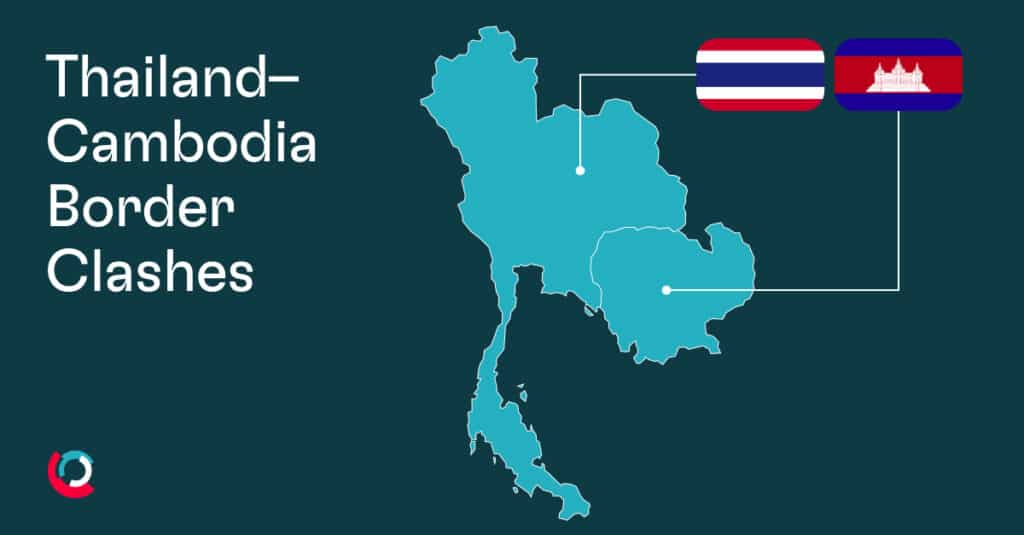
Military skirmishes have escalated along the Thailand–Cambodia border following months of rising tension. Renewed clashes on 24 July 2025 resulted in at least 12 fatalities, including 11 civilians, and prompted the evacuation of over 100,000 people from affected areas, mainly in Thailand’s Sisaket, Surin and Ubon Ratchathani provinces.
The July 2025 clashes underscore the fragility of peace in post-colonial border regions, where undefined boundaries, domestic political instability and rising nationalism converge. While large-scale conflict remains improbable, the outlook remains deeply uncertain.
Travel between the two countries has come to a standstill, with land borders fully closed and bilateral relations severely deteriorated following reciprocal diplomatic expulsions. The Thailand–Cambodia border will probably remain volatile in the coming months, with significant implications for civilian safety, regional mobility and diplomatic relations in Southeast Asia.
Key developments
- Clashes have erupted in multiple disputed zones along the border near Prasat Ta Muen Thom, Prasat Ta Kwai and Chong Bok. These areas are located between Thailand’s Surin, Ubon Ratchathani and Sisaket provinces, and Cambodia’s Oddor Meanchey, Banteay Meanchey and Preah Vihear provinces. The clashes are part of ongoing disagreements over the border, which date back to colonial times.
- Thailand reported airstrikes on Cambodian targets, while both sides exchanged heavy gunfire.
- Triggering events included a landmine explosion in Thailand’s Surin province on 23 July, injuring five Thai soldiers and a fatal clash on 28 May in the disputed Chong Bok border area that killed a Cambodian soldier.
- The Thai military closed all formal border crossings with Cambodia. Cambodia has imposed trade bans on goods and services to and from Thailand while critical border checkpoints on the Cambodian side also remain closed.
Our response: Agility and accuracy
Thailand-Cambodia conflict coverage
- Our team of analysts is working 24/7 to provide clients with accurate, real-time intelligence on the conflict.
- We published 10 alerts alone on 24 July, covering key developments, travel disruptions and escalations.
- As the situation evolves in real-time, so has our Advisory, with frequent updates.
- We are continuously verifying information from official sources, social media and local outlets in multiple languages.
Travel disruptions
Transport and border status:
- Transport Company Limited (Thailand) has suspended all bus routes to Phnom Penh and Siem Reap.
- The overland Thailand-Cambodia border remains closed at all points on the Thailand side, with several key border checkpoints also closed on the Cambodian side.
- Commercial and informal cross-border trade has ceased, severely impacting rural livelihoods and logistics operations on both sides.
Advisories and restrictions:
- Riskline assesses the entire border region as “Extreme Risk”.
- The UK Foreign Office, the Chinese Embassy in Cambodia and several other foreign government agencies have urged their nationals to avoid non-essential travel to the Thailand-Cambodia border areas.
Context and underlying causes
Territorial dispute:
The conflict centres on territorial ambiguity stemming from the 1904 Franco-Thai border treaty when Cambodia was a French colony. The disputed Preah Vihear Temple area, although awarded to Cambodia by the International Court of Justice (ICJ) in 2011, remains contested due to undefined sovereignty over adjacent land.
Nationalism and political tensions:
The escalation coincides with political instability in both countries. Historic grievances have once again become a rallying point for nationalist agendas. On 15 June, Cambodian Senate President Hun Sen published the transcript of a phone call between himself and then-Thai Prime Minister Paetongtarn Shinawatra, the contents of which triggered protests against her in Thailand, the near-collapse of her government and her suspension from office by the Constitutional Court of Thailand. Both acting Thai Prime Minister Suriya Juangroongruangkit and Cambodian Prime Minister Hun Manet, who is Hun Sen’s son, now face significant domestic pressure not to back down.
This pattern echoes previous periods of tension from 2008 to 2011, when similar nationalist mobilisation led to intermittent violence.
Military preparedness and escalation risk
- Thai authorities placed defence forces on standby in all seven border provinces well ahead of the clashes on 24-25 July.
- Cambodian authorities have repositioned troops in Preah Vihear and Oddar Meanchey provinces, with sightings of anti-aircraft systems and mobile artillery.
- While both sides have used heavy artillery fire in recent clashes, Thailand and Cambodia have also shown readiness for protracted standoff conditions.
- The Thai military is much larger and more well-equipped than the Cambodian military, possessing numerical superiority in troops as well as advanced air and naval assets that could threaten Cambodian targets outside the border area.
- The movement of forces in the border area is hampered by the hilly, forested terrain and lack of paved roads.
Impact on Civilians
- Over 100,000 people in Thailand have been displaced from the conflict zones. Emergency shelters are at capacity, with reports of overcrowding and limited access to medical care.
- Civilian movement is heavily restricted near militarised zones; checkpoints are tightly controlled and media access remains limited. At least 5,000 people in Cambodia have been evacuated.
- Cambodian authorities have not published civilian casualty figures, raising concerns about underreporting and transparency.
Diplomatic Fallout
- Thailand expelled the Cambodian Ambassador and recalled its own envoy on 24 July.
- The diplomatic row has strained bilateral mechanisms established after the 2011 ICJ ruling.
- Military dialogue continues sporadically, but political rhetoric on both sides remains antagonistic.
Forecast and outlook
Short-term:
A full-scale war remains unlikely, but intermittent violence, limited airstrikes and cross-border incursions are expected to continue. Airspace closures and further border lockdowns cannot be ruled out.
Medium-term:
Bilateral diplomacy will remain fragile. Talks may resume under pressure from regional partners, but the lack of a clearly demarcated border – and volatile nationalist sentiment- undermines prospects for lasting peace.
Long-term:
The border may become a chronic low-intensity conflict zone unless both governments prioritise de-escalation and establish transparent mechanisms for crisis resolution. There is growing risk of further civilian displacement and regional economic fallout.
Riskline travel advice
- Defer all non-essential travel to areas near the Thailand–Cambodia border until further notice.
- Monitor local media and official government advisories for updates.
- If already in-country, register travel plans with consular authorities and prepare contingency plans.
- If present in conflict-risk zones, shelter in reinforced structures, carry official identification at all times and comply with all security directives.