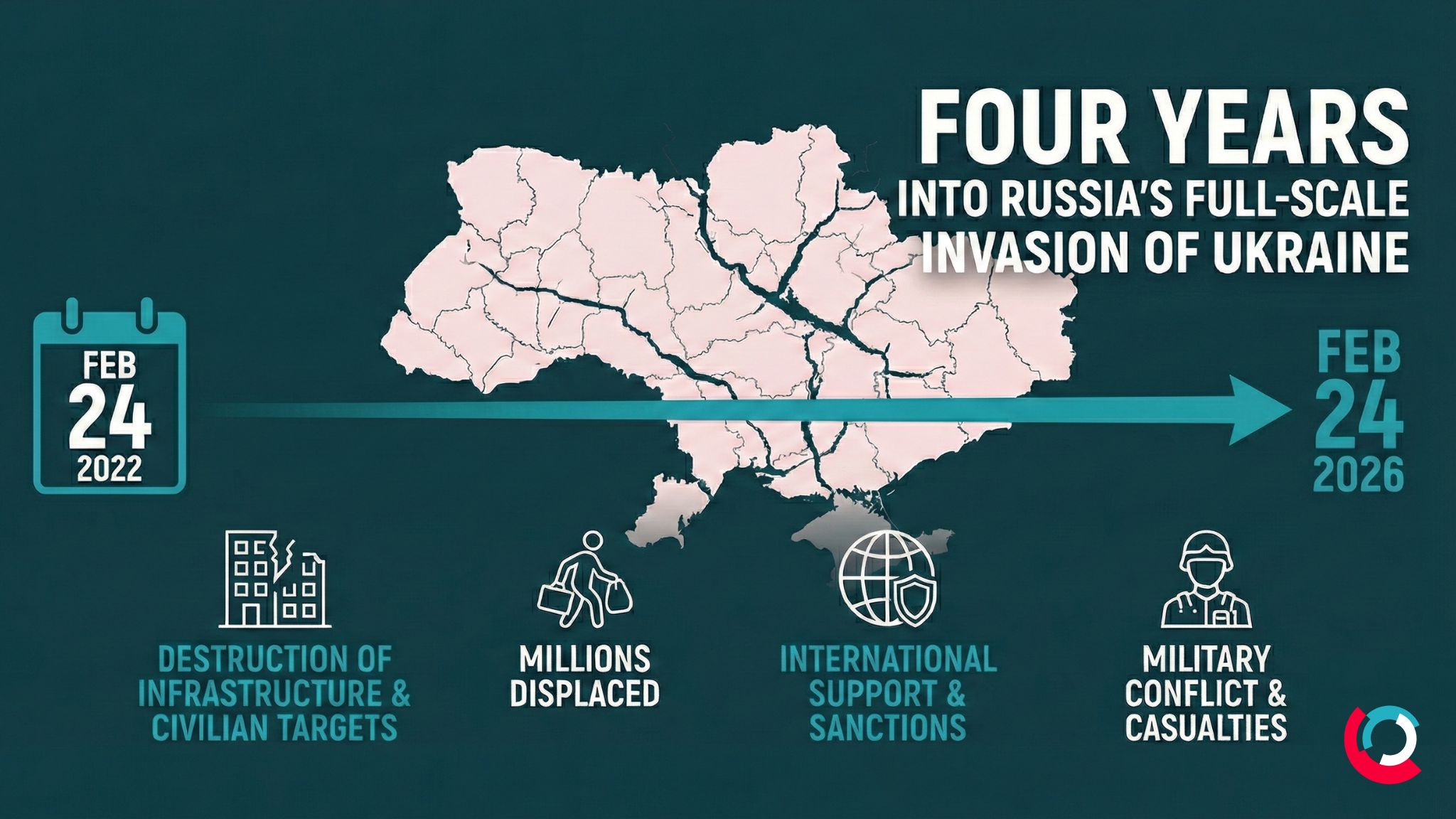
Today marks four years since Russia launched its full-scale invasion of Ukraine. The country has faced profound territorial, military and humanitarian upheaval. After the failure of Moscow’s attempt to seize Kyiv in early 2022, marked by atrocities such as the Bucha massacre, and initially successful Ukrainian counter-offensives to retake territory, the conflict settled into prolonged, high-intensity fighting, particularly in the Donbas. Cities like Bakhmut and Pokrovsk were devastated after months of battles reminiscent of WWI trench warfare.
Critical infrastructure has repeatedly been targeted. Key incidents include attacks on the Zaporizhzhia nuclear plant and the destruction of the Kakhovka dam in 2023, which caused major devastation in the Kherson region. Meanwhile, the Kremlin has tightened its authoritarian control at home, repressing dissent and using historical narratives to maintain domestic support for the war.
Human losses
Accurate casualty numbers remain hard to verify:
- Over one million Russian soldiers killed, wounded, detained or missing, with between 300,000 and 500,000 estimated deaths.
- Total Ukrainian military losses stand near 600,000, with between 100,000 and 200,000 fatalities according to independent assessments.
- At least 65,000 civilian casualties have been recorded, excluding Russian-occupied territories, where the toll is likely higher. Tens of thousands more civilians remain missing or have been forcibly relocated inside Russia.
The conflict has also seen major political and military events, such as the June 2023 Wagner mutiny and a brief Ukrainian incursion into Russia’s Kursk region in 2024-2025.
Security conditions
Russia’s campaign against Ukrainian energy infrastructure has triggered widespread blackouts and service disruptions in Ukraine. Bomb, drone, and gun attacks organised by the Russian security services regularly target public transportation, first responders, and police officers in Ukraine. Flight disruptions are increasingly common in western Russia due to Ukrainian drone and missile attacks on critical infrastructure there. On 25 December 2024, Azerbaijan Airlines flight 8243 was shot down over the Caspian Sea by Russian air defences after mistaking it for a Ukrainian drone.
What to expect
- Continued long-range strikes and localised fighting in contested regions.
- Disruption to transport, utilities, and public services in affected areas.
- Ongoing humanitarian challenges, including limited access to medical care and infrastructure.
Travel guidance
- Seek shelter at the first sign of shelling or attack.
- Avoid security and government sites.
- Maintain essential supplies.
- Carry identification.
- Comply with curfews and movement restrictions.
Our commitment
“Our team monitors Ukraine in real time, providing verified intelligence while adapting coverage to its diverse operational environment: high-intensity combat in the east, and life amid air raid threats in the west and central regions”
Nikita Billier, EMEA Operations Manager