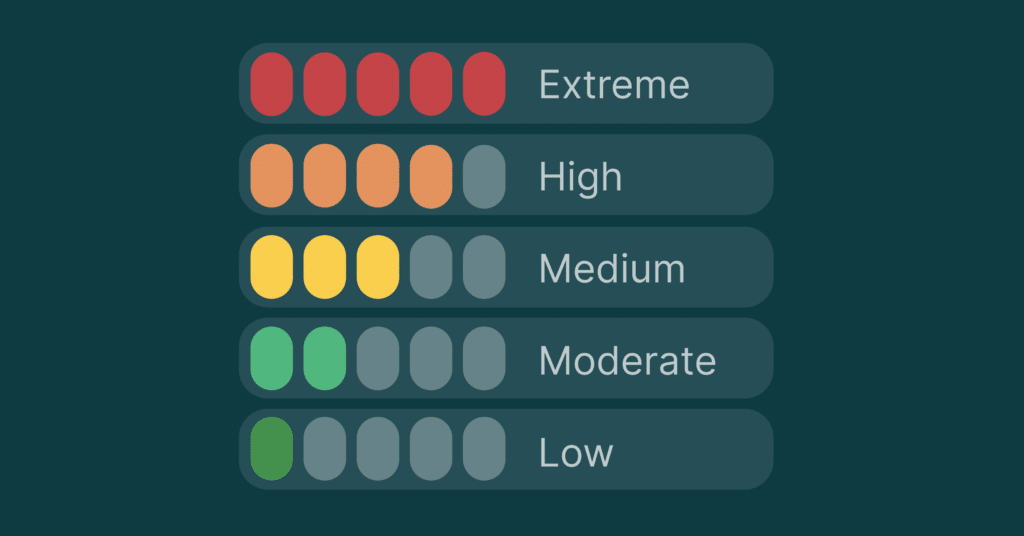
At Riskline, we assess risks in every report we publish using a structured methodology grounded in internationally recognised travel risk management practices. This methodology allows us to categorise risks into five distinct levels—low, moderate, medium, high and extreme. Each reflects specific safety concerns, security conditions and potential travel disruptions.
How Do We Determine Risk Levels?
Risk levels are determined using a straightforward equation:
Risk level = Likelihood of occurrence × expected or actual Impact
Our analysts assess both the probability of a threat occurring and the severity of its impact on travel, safety and health. For instance, a low risk situation typically involves minimal disruptions and few security threats, while an extreme risk situation is highly dangerous, unpredictable and could render travel impossible.
How We Assess Probability
To ensure accurate risk analysis, we evaluate how often specific threats occur:
| Probability | Likelihood of occurrence |
| Certain | Over 90%, occurring almost daily |
| Likely | 60-90%, happening every few weeks to months |
| Possible | 30-60%, occurring every few months to years |
| Unlikely | Below 30%, seen every few years to decades |
Breakdown of Risk Levels
| Risk Level | Safety and Security | Travel Disruptions |
| Extreme | Extremely dangerous, unpredictable risks | Chaotic; travel may be impossible |
| High | Dangerous with unexpected risks | Widespread or localised disruptions; travel is difficult |
| Medium | Predictable risks but not completely safe | Travel possible with potential disruptions |
| Moderate | Generally safe with some predictable risks | Travel possible with routine delays |
| Low | Safe with few security risks | Minimal to no disruptions |
Understanding Impact Levels
In addition to evaluating risk levels, we classify the impact of an event based on its effects on travel, personnel safety and asset damage:
- Catastrophic: Complete disruption of transport, mass casualties and total asset loss.
- Severe: Widespread transport disruption, severe injuries and significant damage.
- Major: Notable disruptions, serious injuries and substantial damage.
- Minor: Minor delays, low stress and limited damage.
- Negligible: No disruption, injuries or damage.
Why This Matters
Our risk assessment methodology is more than a structured risk assessment framework, it ensures businesses and travellers benefit from:
- Consistency in evaluating risks, regardless of the threat, hazard or location.
- Clarity to make complex assessments easy to interpret.
- Practicality, with each risk level linked to clear guidance, enabling managers and travellers to make informed choices, whether for immediate action or future planning.
By adopting this approach, companies and individuals can avoid risks where possible and mitigate them when necessary.
Want to learn more? Request a demo to discover how our methodology can support your travel risk management strategy.