Duty of care has evolved far beyond traveller tracking and compliance checklists. For companies operating in high-risk, highly regulated industries, real-time travel risk intelligence and the ability to act on it can make a critical difference.
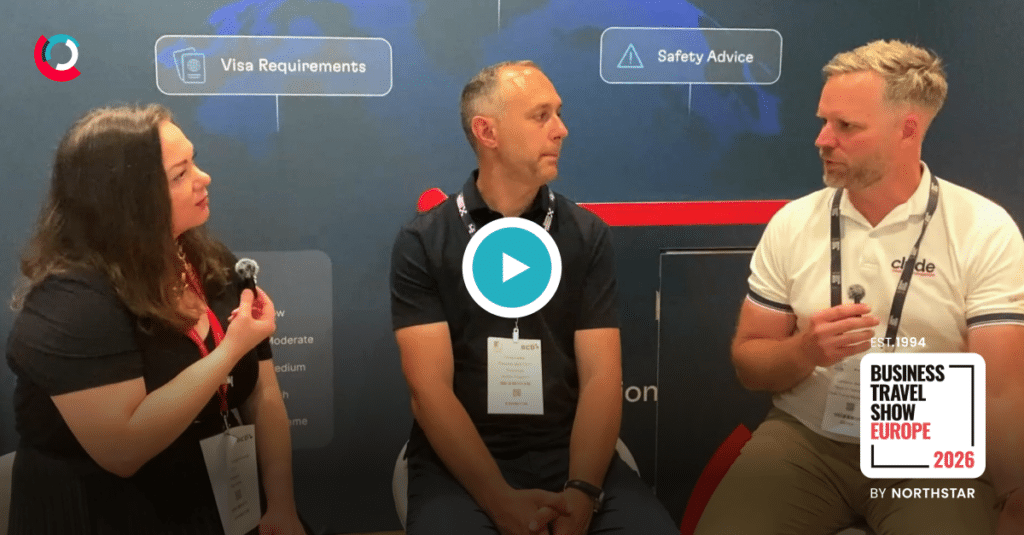
At the 2026 Business Travel Show Europe in London, Riskline CEO Suzanne Sangiovese spoke with Chris Lewis, CEO and co-founder of the data management company Travelogix, and Cameron Bengert, Head of Operations at Clyde Travel Management, about how the three companies work together to support traveller safety and operational decision-making.
At the heart of this collaboration is “Geo”, Travelogix’s duty of care platform, which brings together traveller locations and up-to-date travel risk information. It delivers Riskline’s real-time Alerts and detailed map overlays highlighting safety risks, incidents and global health concerns worldwide.
As a Travelogix client, Clyde Travel Management uses the platform’s tracking capabilities alongside Riskline’s intelligence to monitor global disruptions and support its customers.
Watch the full video interview here.
Suzanne: Can you tell us a little about Clyde Travel Management? How have you been approaching duty of care?
Cameron: We are an international travel management company based in Glasgow, specialising in the marine and offshore industries, which are highly compliance-driven.
Duty of care is really what gets us in the room with our clients. You cannot work in these sectors without having a robust duty of care solution. It’s not just about ticking a box or offering a map. It’s about being able to act on intelligence and ensuring travellers are safe while doing their work.
Suzanne: How are you using Travelogix’s technology?
Cameron: We are using “Geo” and providing our clients with access to the tool as well. Through the platform, we are consuming Riskline Alerts.
These Alerts are crucial for us, especially right now, in a volatile world. Our clients travel through major shipping and energy hubs worldwide, so we need to not only respond to a crisis, but also understand where travellers are and what events are happening around them, act on that intelligence and find new routes.
Crew travel is different from traditional corporate travel. A corporate traveller may cancel a trip or fly home. The crew is going to work on ships or offshore rigs for a period of time and they need to get home. We must solve those situations when disruption occurs. Intelligence from around the world is absolutely crucial for us to be able to do that.
Suzanne: So you’re really doing people risk management, not just travel risk management?
Cameron: Exactly. We work closely with our clients’ logistics teams, which often have strict compliance requirements governing where people can travel. Even when there isn’t an active crisis, we need to understand which travellers may be affected by possible future disruptions and have plans ready for those situations.
Suzanne: Chris, how do you ensure your technology works for different TMCs?
Chris: I realised our clients wanted something straightforward: see where their travellers were, when they would be there and understand the Alerts around those travellers in context.
A lot of our competitors focus on GPS tracking, extraction services and similar capabilities. Many of our customers don’t need that. They need fast response, trusted information and to have a resolution in place. For us, we can be really flexible because we keep things simple.
When it came to partnering with Riskline, the quality of the data, API, Alerts and Advisories far exceeded anything else. Being able to use that intelligence within a simple user interface serves so many purposes.
Suzanne: Recent global events, such as this year’s conflict in the Middle East, have created significant disruption. How has technology and intelligence helped you manage these situations?
Cameron: During the pandemic, we had to monitor daily updates on border restrictions, transit rules and entry requirements, which pushed us to develop better systems and processes to handle large volumes of information.
More recently, the conflict in the Middle East created similar challenges. We’re now using technology, including AI, to show us which Alerts need our action. “Geo” also helps us identify which clients are affected by specific Alerts so we don’t have to manually review every single update.
That’s when the real work begins. That’s when we concentrate on solving the problem, whether that’s identifying alternative routes, arranging repatriation or understanding visa implications.
Suzanne: Chris, how have these disruptions influenced product development at Travelogix?
Chris: We realised that there is a need not to make too much noise about the wrong thing. We’re now developing a more granular subscription to Alerts. Using the vast degrees of granularity we get from Riskline and the data gathered, we’re matching hotel locations, down to the longitude and latitude, against the coordinates of an Alert. This would allow “Geo” users to define exactly which updates they receive, for example, only notifying them when travellers are within a specified distance of a high-risk incident.
We’re also building two-way communication channels, so travellers will be able to confirm whether they are safe or require assistance. If they don’t respond, the platform would automatically trigger a follow-up action.
Suzanne: So you’re creating value through personalisation, not just information volume. Cameron, how do you see companies managing these different risk appetites?
Cameron: There’s commercial pressure balanced against risk considerations. Our industries take health and safety seriously, given the compliance involved. But when a situation is becoming safer, customers want to know that and what’s happening on the ground, so they can act quickly, whether that’s FCDO advice changing, routes reopening or safe corridors emerging.
Our job is to help those risk decisions be made with more information. We can’t make those
decisions on our clients’ behalf, but we can help inform them.
Suzanne: Looking ahead, what does the future of duty of care look like?
Chris: For us, communication is critical. Once two-way communication is in place, the next step is multimodal, not just email, but SMS and WhatsApp too.
We’re also implementing Riskline’s TripReady solution, which will let us show passengers what they need to know before a trip, rather than alerting them once something’s already happened. It’s about getting the right information to the right person at the right time.